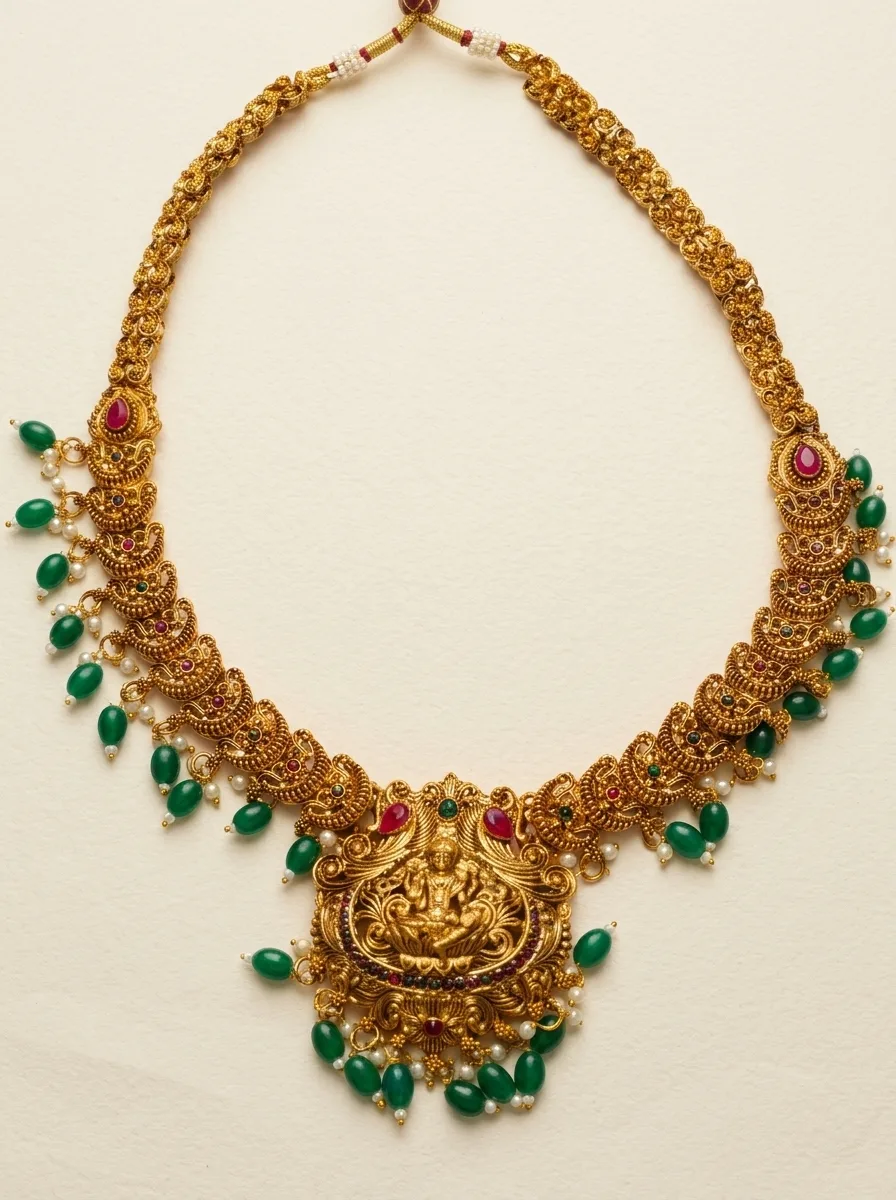
Assamese traditional jewellery has distinctive designs rooted in local culture and nature. Many pieces were historically made with red stones (often called "mina" in the region) in gold, and they remain central to Bihu celebrations and Assamese weddings. Imitation versions let more families buy the look.
Assamese pieces and what they are
| Piece | What it is |
|---|---|
| Jonbiri | Necklace with a crescent moon-shaped pendant |
| Dugdugi | Necklace with a heart or leaf-shaped pendant |
| Golpata | Flat choker with floral designs, sitting at the base of the neck |
| Lokaparo | Earrings or pendant with two birds placed back to back |
| Dholbiri | Drum-shaped pendant |
| Keru and thuria | Traditional ear ornaments |
| Gamkharu | Thick bangle, often hinged, worn at weddings and festivals |
| Bena | Crescent-shaped necklace pendant |
Many designs take their shapes from nature and daily life - the crescent moon, the leaf, birds, drums - and customers recognise these forms and their names. When commissioning imitation pieces, keep to the traditional shapes: a loosely "inspired" design, or a generic North Indian design sold as "Assamese", will not sell to buyers who know the originals.
Style
Traditional Assamese jewellery uses gold or gold-plated silver with red meena (enamel), red stones and small beads. The look is lighter and more delicate than South Indian temple jewellery. A convincing imitation needs bright, even red meena (the signature of the style), flat, light and finely detailed pendants, uniform beads and gold-tone spacers, and clearly shaped jonbiri crescents and lokaparo birds.
Bihu, weddings and performance groups
The biggest occasion is Rongali (Bohag) Bihu in mid-April, the Assamese New Year, when women dress in mekhela chador and traditional jewellery for dances and celebrations; Bhogali Bihu in January and weddings are the other major occasions. Bihu dance troupes, school groups and cultural associations buy matching sets in quantity every year, at sensible prices, delivered before Rongali Bihu - a distributor who builds relationships with them gains a predictable annual order.
A starter range, and stocking tips
| Piece | Designs to start with | Why |
|---|---|---|
| Jonbiri and dugdugi necklaces, with matching earrings | 3 to 4 | Bihu and bridal |
| Golpata chokers | 2 to 3 | Bridal |
| Lokaparo and keru earrings | 3 to 4 | Bihu, bridal, gifting |
| Gamkharu bangles | 2, in sizes that fit most wrists | Weddings and festivals |
Have Bihu stock in shops by March. Guwahati distributors can combine local designs with national bridal lines, and a small online range reaches Assamese communities in Delhi, Kolkata, Bengaluru and abroad; customers from other regions also buy jonbiris and golpatas as distinctive fashion pieces.
Quality points
Red stone colour matched, enamel clean, gamkharu hinge strong, pendant hang balanced.
Working with a manufacturer
Share reference photos of traditional pieces, and ask for the red stone tone to match the traditional look. We make regional designs to order at 200 pcs per design (400 for earrings and pendants). See bridal jewellery manufacturer and the Guwahati market guide.
Briefing Assamese pieces
Share photos of traditional pieces, specify the red stone tone, pendant sizes and whether gamkharu should be hinged. Ask for a physical sample to check proportions against a real piece.