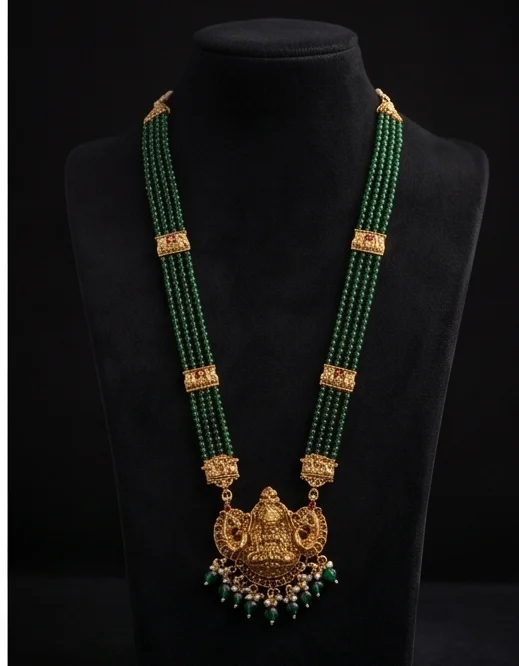
The quality of a custom piece depends a lot on the quality of the brief. A clear brief gets you a close first proof, fewer revisions and a sample you can approve. A vague one gets you guesswork.
What to include
1. References. Photos of the piece or pieces you want. If you like the neckline of one and the pendant of another, say so and mark it on the images.
2. Size. Length of necklaces, pendant size, earring drop length, bangle size. If unsure, share a photo of the piece being worn.
3. Weight preference. Light for daily wear, or heavy for bridal. This affects base metal choice.
4. Finish. Antique gold, matte gold, high-polish gold, rhodium, rose gold or oxidised. A photo of the tone helps.
5. Stones. Kemp, CZ, Kundan glass, pearls or beads, with colours. "Ruby red with green accents and white CZ border" is a good description.
6. Target price. The factory price you need to hit your MRP. This lets the factory suggest adjustments early.
7. Quantity. Units per design and whether colour splits are needed.
8. Deadline. When you need stock at your warehouse.
9. Packing. Plain pouches, cards, boxes, or branded packaging.
10. Market. Where the piece will sell. A design for Chennai brides and one for Delhi party wear need different choices.
A sample brief
"Temple choker similar to photo 1, but with the Lakshmi pendant from photo 2. Width about 4 cm. Antique gold, medium weight. Ruby kemp with green accents, pearl hangings. Target factory price as discussed. 400 units, 200 red-dominant and 200 green-dominant. Needed before the wedding season. Individual pouches."
Mistakes to avoid
- Sending one blurry photo and "make like this"
- Changing the design after sample approval
- Leaving price to the end, then asking for cuts that change the look
- Not saying where the piece will sell
What happens next
At Jagruti, we reply with feasibility and timeline, usually the same day, then model the piece in 3D CAD and send a rendered proof. After your approval, a physical sample is made. Start with our custom design service.
A brief template you can copy
| Field | Example |
|---|---|
| Product type | Long necklace set with earrings |
| Reference | Two photos attached; keep the peacock motif, simplify the border |
| Size | Necklace about 16 inches plus 3-inch adjustable chain; pendant about 5 cm |
| Base metal | Zinc alloy |
| Finish | Antique gold, medium darkness |
| Stones | Centre ruby kemp, border emerald, white CZ accents |
| Pearls or drops | White pearl drops along the lower edge |
| Weight target | Comfortable for a full day's wear |
| Quantity | 400 sets, possibly two colour versions of 200 each |
| Target price | Per set, to fit a retail price point |
| Packaging | Individual zip bag with anti-tarnish strip, set in one bag |
| Deadline | Stock needed in your warehouse by a given date |
The more of these fields you fill, the fewer rounds of questions and proofs you need.
Giving references without copying
References are how customers describe what they want, and factories expect them. But copying another brand's signature design exactly can create legal and reputational problems, especially if the design is registered. A good brief takes the idea (the motif, the proportions, the colour story) and asks for an original design in that style. A good factory will suggest how to adapt it.
How many revisions to expect
For a new design, expect one or two rounds of changes on the CAD proof, and occasionally a small change after the physical sample. Each round is quickest when your comments are specific: "make the pendant 20% smaller" is actionable; "make it look richer" needs a conversation.
Questions the factory will ask you
Expect a good factory to come back with questions such as:
- Is this for daily wear, festive wear or bridal?
- What retail price will it sell at?
- Should it match an existing set in your range?
- Do you need it in more than one colour?
- Is there a weight limit for comfort?
- Will it be sold in India or exported?
Answering these before you are asked speeds everything up. The answers change how the factory designs the piece: a bridal pendant can be heavier and more detailed; a daily-wear piece has to be light and robust at a lower price.
Budget for the design stage
Custom designs usually carry a design charge for CAD work and a master, separate from the production price, especially when the buyer supplies only a photo. Agree the design charge, what it covers (for example two rounds of changes) and whether it is adjusted against the bulk order before the work starts.