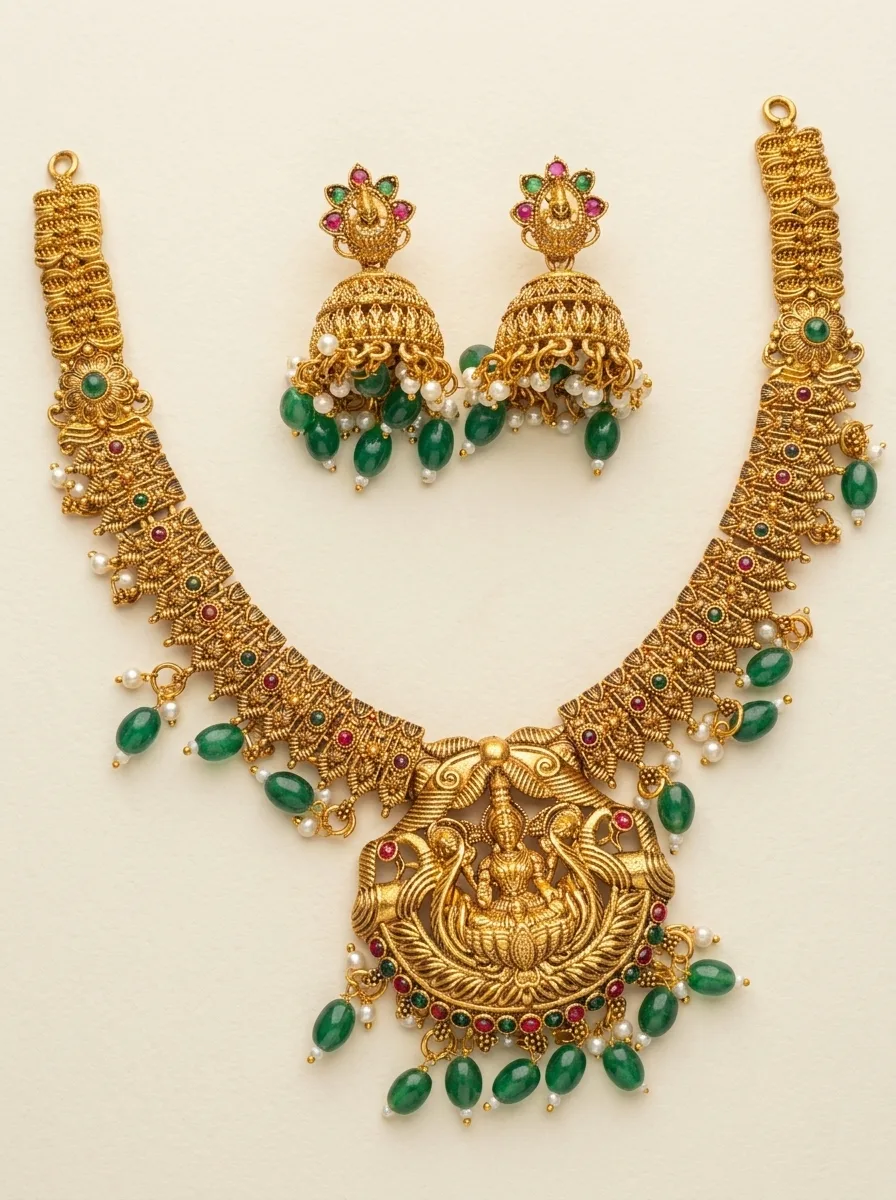
The long haaram is the signature South Indian necklace, worn by brides, at temple festivals and on family occasions. For wholesalers supplying the South and its diaspora, haarams are core stock.
Popular haaram designs
| Type | Description | Where it sells |
|---|---|---|
| Lakshmi haaram | Long chain with a large Lakshmi pendant or Lakshmi coins, often with kemp | South India, diaspora |
| Kasu mala / kasulaperu | A long chain of Lakshmi coins | Tamil Nadu, Andhra, Telangana |
| Manga malai / mango mala | Mango-shaped motifs, often with kemp | Tamil Nadu, Karnataka |
| Guttapusalu haaram | Clusters of small pearls hanging from the motifs | Andhra, Telangana |
| Peacock haaram | Peacock motifs with kemp and pearl hangings | Across the South |
| Nakshi haaram | Engraved, textured antique work | Across the South |
| Bead haaram | Green, red or pearl beads with a temple pendant | Festive and guest wear |
Length, weight and wearing style
Long haarams typically run from about 24 inches to well over 30, falling to the waist or just above. They are usually worn with a shorter choker above them and, for brides, a waist belt below - check that the haaram's length sits correctly with your choker range and that the pendant does not clash with the waist belt.
They are among the heaviest imitation pieces. Zinc alloy keeps weight down for detailed designs; brass is used where heft signals value. Either way, ask for flexible links so the haaram drapes rather than sitting stiffly, a pendant balanced so it does not pull the necklace forward, and a secure hook that will not open under the weight.
Quality checks
- Sharp motif detail on coins and pendants
- Even antique tone along the length
- Matched kemp colours
- Pearls and beads securely strung
- Strong hook or screw clasp
- Anti-tarnish packing
Stocking by customer
| Customer | Haaram type |
|---|---|
| Brides | Heavy Lakshmi or Guttapusalu haarams with choker |
| Family and guests | Lighter Lakshmi and bead haarams |
| Dancers | Kemp-heavy temple sets |
| Festival buyers | Mango mala, kasu mala |
Seasons and re-orders
South Indian wedding months, Varalakshmi Vratham, Navaratri, Deepavali and Pongal drive demand; for the diaspora, Deepavali and wedding seasons abroad. Haarams are among the slowest pieces to produce because of their length, number of motifs and stones, so plan orders and re-orders of your best designs early.
Pairing and selling
Haarams sell best as part of a complete look. Display them with the coordinated choker and jhumkas beside them and offer "haaram plus choker" pairings for brides: customers buying for a specific function want the matching pieces, the average sale rises, and she leaves with everything she needs for the occasion.
How haarams are made
A haaram is usually built from repeated units, such as coins, mango motifs or pearl clusters, joined in a chain, with a central pendant. Each unit is cast, plated and set, then linked by hand. That modular build means one design can be offered in two lengths without a new mould for every part, which is useful when you want a heavy bridal version and a lighter guest version.
Display and care advice
Haarams tangle if stored loosely. Advise retailers to keep each haaram flat in its pouch and to display them hanging. Tell customers to lay the haaram flat after wearing and wipe it with a dry cloth before storing, especially in humid coastal cities.
Haarams for dance
Dance haarams are usually shorter and lighter than bridal ones, so they move with the dancer without swinging. Dance schools often ask for a long haaram and a short necklace as a pair, in matching kemp colours. If you supply dance schools, keep a lighter haaram design in the range specifically for them.
We make long haarams at our Mumbai factory at 200 pcs per design (400 for earrings and pendants). See temple jewellery wholesale.