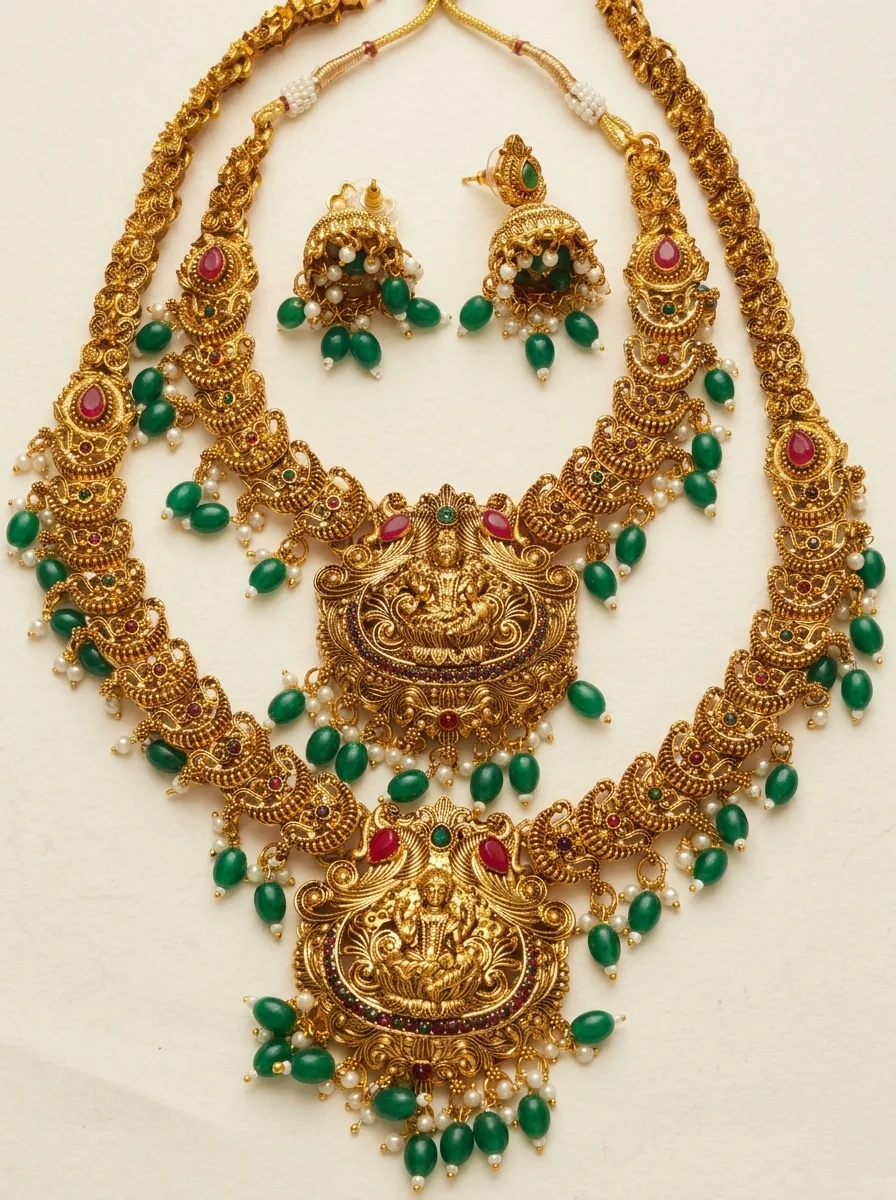
Marwari families live across India, in Kolkata, Mumbai, Hyderabad, Chennai, Bengaluru, Assam and beyond, while keeping Rajasthani bridal traditions. That makes Marwari bridal jewellery a national market for Rajasthani styles, not only a Rajasthan one.
Traditional Marwari bridal pieces
- Rakhdi (borla): the round forehead ornament, a sign of marriage.
- Aad and timaniya: broad chokers, often Kundan-meena; aad with rani haar is a common pairing.
- Rani haar: long layered necklace.
- Nath: large, often with a chain.
- Bajuband: armlets; hathphool: hand ornaments linking bracelet and rings.
- Kada, bangles and chooda: heavy Kundan-meena bangles, often with ivory-look or red bangles.
- Kamarbandh: waist belt; payal and bichhiya: anklets and toe rings.
Style and colour
Kundan-meena, polki-look and jadau-style pieces with red, green and pink stones and pearls. Marwari bridal outfits often use deep red, pink and orange, which red, green and white stones and pink meena complement. Offer colour variants of your best designs so retailers can match outfits, and check the meena on the reverse - weak colour there is a common fault.
Festivals that matter
- Gangaur (March or April): women worship Gauri and dress in traditional jewellery.
- Teej (July or August): a major festival for married women.
- Karva Chauth, Diwali and Akshaya Tritiya, when buying jewellery is considered auspicious.
- Weddings, which are often large, with many functions and guests.
Gangaur and Teej matter as much as Diwali to many Marwari families: they call for tikkas, borlas, jhumkas and bangles, so have stock with retailers several weeks before each.
A distinct market across India
Marwari families live in almost every major Indian city - especially Kolkata, Mumbai, Delhi, Hyderabad, Chennai, Bengaluru, Guwahati and across Assam and the North-East - and in Nepal. Many keep traditional bridal customs even as they adopt local styles for daily life: a Marwari bride in Kolkata may wear a borla and aad for the wedding and Bengali-inspired pieces for other functions. For distributors outside Rajasthan, Marwari customers are often the core buyers of Kundan-meena, rakhdi and aad designs, so a dedicated Rajasthani bridal range works better than general North Indian sets.
Stocking tips, and family sets
- Lead with rakhdi, aad and Kundan-meena bridal sets for brides.
- Marwari families often buy matching sets for several women for a wedding, so offer the same design in several colours and weights, from heavy bridal to lighter guest versions - a manufacturer can produce these from the same moulds. Offering only heavy bridal pieces misses this.
- Some families keep an imitation bridal set for relatives to borrow, which favours durable pieces with strong fittings.
We make Marwari and Rajasthani pieces at 200 pcs per design (400 for earrings and pendants). See Kundan and Polki wholesale and Rajasthani jewellery wholesale.
Briefing Marwari designs
Share references, specify Meena colours, stone colours, borla size and the necklace combination (aad with rani haar is a common pairing). Ask for a physical sample to check colour and reverse-side finish.