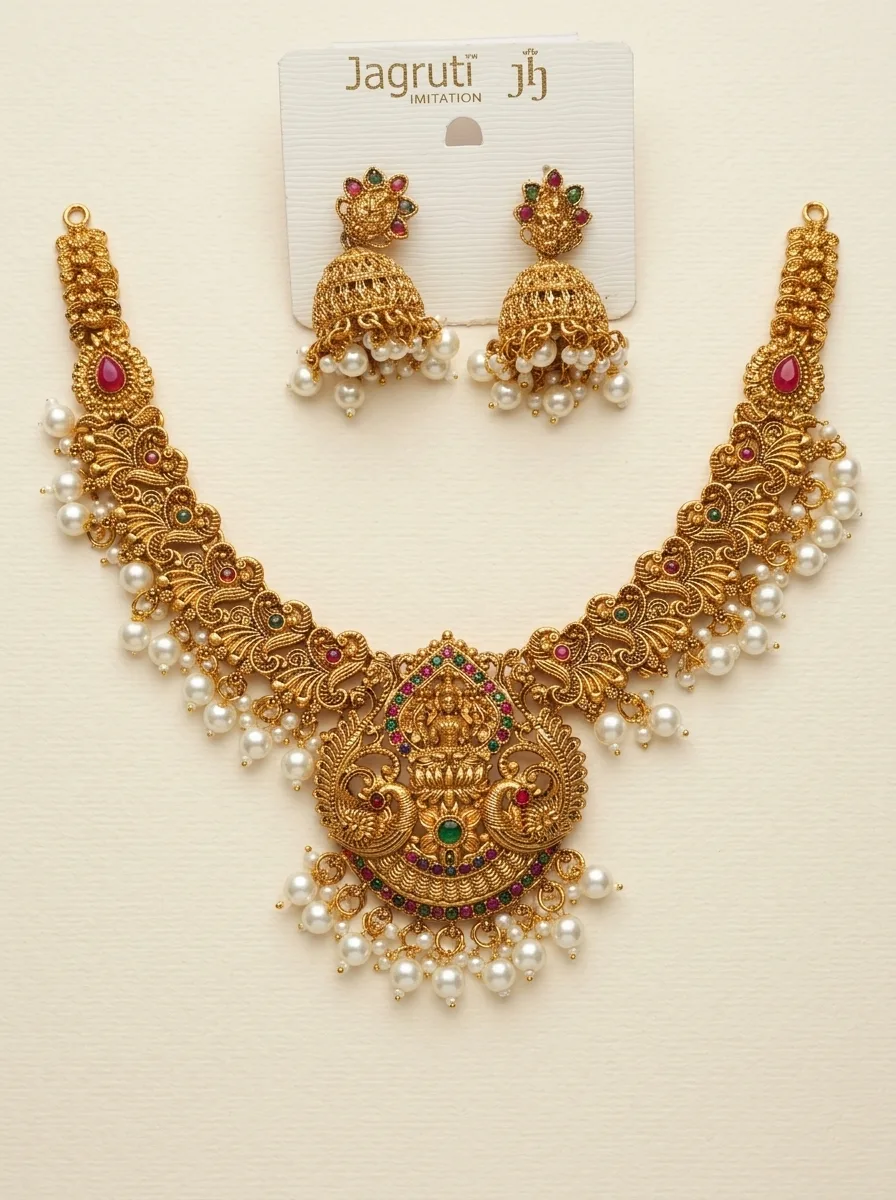
Nakshi work is a style of South Indian jewellery with deeply carved, three-dimensional relief: deities, animals, flowers and temple scenes standing out from the surface. In gold, it is painstaking handwork. In imitation, the look is created through detailed moulds and careful antique finishing.
What nakshi means
"Nakshi" means engraved or carved design. Nakshi jewellery is covered in finely detailed relief work - deities (Lakshmi, Krishna, Ganesha), animals, flowers and temple scenes raised from the surface - with granulation and fine texture, and often minimal stones, letting the metalwork speak. In traditional gold work the design is created by repousse, pushing the metal out from behind, and chasing, refining it from the front. It is closely associated with South Indian temple jewellery, especially in Andhra Pradesh, Telangana and Tamil Nadu, and customers link it with heirloom gold passed down through families.
Pieces that sell
- Long nakshi haarams with deity pendants
- Nakshi chokers and pendants
- Nakshi bangles and kadas
- Nakshi jhumkas with deep relief bells
- Nakshi vaddanams (waist belts) with Lakshmi or peacock panels
How imitation nakshi is made
Imitation nakshi reproduces the relief in the casting itself. The master is carved by hand or modelled in 3D CAD with the full depth of the relief, then moulded; the casting must fill every recess, which is why zinc alloy (Mazak) is often used for its fine flow. Antique finishing then darkens recesses and highlights the relief. Read Mazak material meaning.
Deep relief adds metal, and so weight. For wearable pieces, manufacturers can hollow the back of motifs or use lighter alloys while keeping the front detail intact - ask about weight on the sample and whether the back can be lightened.
Quality points
Look at the finest details - faces, fingers, feathers - under good light, and compare several units side by side: the relief should be equally sharp on every piece. Soft or blurred detail means a worn mould or poor casting.
| Check | Why |
|---|---|
| Depth of relief | Shallow casting looks flat |
| Face detail | Deity faces must be clear |
| Antique contrast | Brings out the carving; a flat, muddy or over-polished finish undoes it |
| Weight | Deep relief adds metal |
Advise customers not to polish nakshi pieces: polishing removes the dark antique contrast that shows the relief.
Stocking and pairing
Nakshi pieces are premium temple items, bought by people who want the heritage look for weddings and festivals without the cost of gold, and by customers who find kemp-heavy designs too colourful. Stock a few heavy nakshi bridal haarams as heroes and a broader range of nakshi jhumkas and bangles for festive buyers. Display them up close, in good light - they sell on detail. They pair well with plain silk sarees, where the metalwork stands out, and with kemp chokers and temple jhumkas for a layered South Indian bridal look.
We make nakshi-style designs at 200 pcs per design (400 for earrings and pendants). See temple jewellery wholesale and 3D CAD design.
Briefing a nakshi design
Share clear references of the carving style you want, specify dimensions and depth, and say whether stones should be added. Ask for a CAD render with lighting that shows the relief before approving.