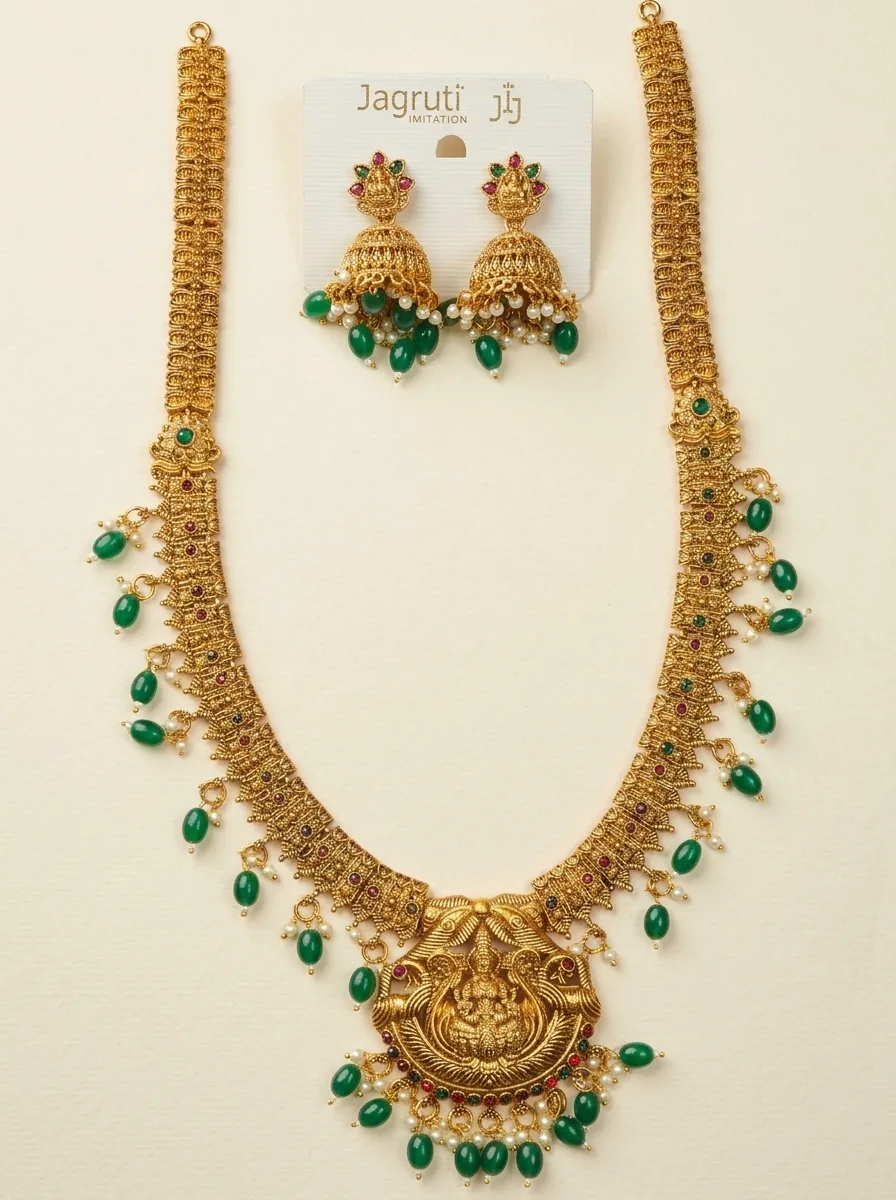
Rajasthani jewellery is bold and colourful, shaped by Rajput royal traditions and the craft of Jaipur. For wholesalers, it serves Rajasthan, Marwari communities across India and abroad, and fashion buyers who love its colour. It is also one of the richest sources of design ideas for Kundan and Meena work.
Key pieces and their names
| Piece | Where it is worn | Notes |
|---|---|---|
| Borla or rakhdi | Forehead | A round, dome-shaped ornament on a chain along the parting; a sign of marriage |
| Aad | Neck | A broad, flat choker, a signature of Rajputi bridal wear, often Kundan-meena |
| Timaniya | Neck | A choker of three or more rows, traditionally worn by married Rajput women |
| Bajuband | Upper arm | Armlet, often with dori ties |
| Hathphool | Hand | Bracelet linked to rings by chains |
| Gokhru | Wrist | Spiked, studded bangles |
| Nath | Nose | Large round nath with a chain |
| Kamarbandh | Waist | Waist belt |
| Kadla, pajeb and payal | Ankles | Heavy anklets |
Style: Kundan-meena, and colours that sell
Rajasthan, and Jaipur in particular, is the historic centre of Kundan and meenakari work. Traditional pieces combine Kundan stones on the front with brilliant enamel colours on the reverse; imitation Rajasthani jewellery follows the same idea, with Kundan-look stones in front and cold-enamel colour on the back. Polki-look stones, pearls and emerald-look drops are common. Rajasthani customers value the reverse as much as the front, so check both sides of samples.
Red, green and white remain the classic combination, with pink and green meena popular for Rajasthani and Marwari bridal wear and pastel versions growing for younger brides. Jewellery is often matched to bandhej and leheriya outfits, so strong colours sell better here than in many other regions - muted colours are a common stocking mistake.
Seasons
Weddings, Teej, Gangaur, Karva Chauth and Diwali. Gangaur and Teej are especially important in Rajasthan and among Marwari families.
What sells in imitation
Borla and aad lead for bridal. Kundan-Meena jhumkas and maang tikkas sell widely outside Rajasthan too. Hathphool and bajuband complete bridal sets and sell well to rental businesses.
Quality points
- Meena colour clean at edges, no chips
- Kundan foil bright behind every stone
- Borla shaped evenly with a secure hook
- Aad flexible enough to sit on the neck
- Pearls and drops strung securely
Stocking tips
Stock complete Rajputi bridal sets for Rajasthan and Marwari markets, and individual Kundan-Meena earrings and tikkas for wider national sale. Offer colour variants: pink Meena and green-red Meena suit different outfits.
We make Rajasthani styles at 200 pcs per design (400 for earrings and pendants). See Kundan and Polki wholesale, Meenakari wholesale and the Jaipur market guide.
Why Rajasthani designs travel
Rajasthani jewellery has become a national fashion language. Customers in Mumbai, Bengaluru and Hyderabad with no Rajasthani roots buy Kundan-meena jhumkas and borla-inspired tikkas because they photograph well and suit festive outfits, and Marwari communities, tourists and export buyers buy the full styles. For a national distributor, a small Rajasthani line often sells beyond its home market, especially at Navratri, Diwali and the wedding season.
Briefing Rajasthani pieces
Give colour references for the Meena, the stone colours for the front, the borla diameter and chain length, and whether you want an aad with a dori or a hook. Ask to see the reverse side of the sample: Meena quality on the back is part of what Rajasthani buyers pay for.
Selling tip
Display the borla and aad together on a bust or neck form with a bandhej dupatta: customers immediately see the Rajasthani look and are more likely to buy both pieces.