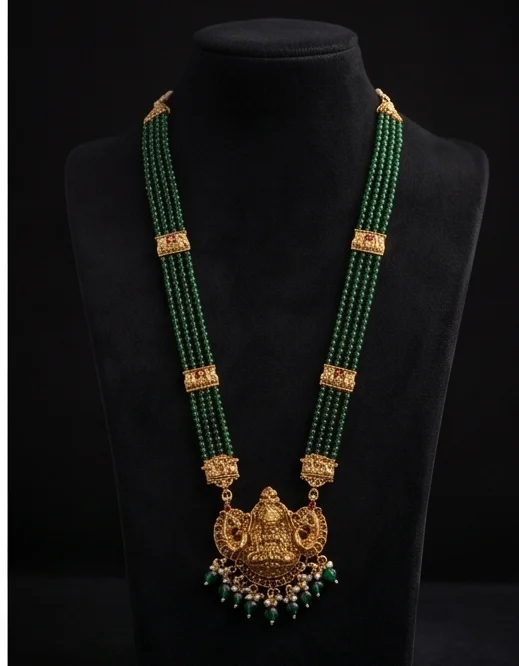
"One gram gold jewellery" is one of the most searched terms in Indian fashion jewellery, especially in South India. It is also one of the most misunderstood. For wholesalers, clear understanding protects both your customers and your business.
What the term usually means, and where it comes from
In the trade, "1 gram gold" generally describes gold-plated or gold-covered jewellery with a heavier or better-quality gold finish than ordinary imitation pieces, often on a brass or copper-rich base, with a bright yellow look close to real gold jewellery. It does not reliably mean the piece contains one gram of gold - the actual gold content varies widely, and may be close to none in cheaper pieces. The phrase is a category name, not a measurement.
It is strongly associated with Machilipatnam (also called Bandar) in Andhra Pradesh, which grew into a well-known centre for gold-covered jewellery that looks like traditional gold designs.
How it differs from regular imitation jewellery
| "1 gram gold" style | Regular imitation | |
|---|---|---|
| Look | Bright, real-gold-like yellow | Varies: antique, matte, bright |
| Base | Often brass or copper alloy | Mazak or brass |
| Designs | Copies of gold jewellery designs | Wide variety |
| Price | Usually higher | Wide range |
Popular pieces
Chains, haarams, bangles, mangalsutras, earrings and necklace sets that closely resemble traditional gold designs, especially South Indian ones such as Lakshmi coins, mango malas and kasu malas.
Labelling honestly
Because the name contains "gold" and the look is close to real gold, honest labelling matters especially here:
- describe it as gold-covered or gold-plated jewellery on a base metal
- never use purity marks, karat numbers, "916" wording or hallmark-like stamps
- never suggest it has resale value like gold
- give a care card, since the gold-colour layer wears with use - most where it rubs: the inside of bangles, clasps and earring backs. Advise customers to rotate pieces and store each separately.
Customers who feel misled do not return, and misleading claims can create legal problems.
Quality checks
- Colour close to the reference and consistent across units
- Even plating with no thin spots at edges
- Smooth finish on chains and clasps
- Protective coat present
- Strong, well-made findings for daily wear
Who buys it, and what they expect
Customers who want a daily-wear or event look that matches their real gold jewellery, families buying for relatives, and travellers who prefer not to carry gold. Demand is strongest in Andhra Pradesh, Telangana, Tamil Nadu, Karnataka and Kerala, and among the diaspora. They want the traditional designs of their region - long haarams, kasu malas, bangles and bridal sets - with a bright or slightly antique yellow gold look and fewer stones than kemp jewellery, convincing next to real gold and lasting through regular wear. Keep the classic kasu mala, long haaram and bangle designs in steady supply and add seasonal designs around them.
Sourcing and pricing
For wholesale buyers, the questions are the same as for any gold-plated jewellery: base metal, plating layers, finish colour matched to the approved sample, and a protective lacquer. Ask for the finish tone to be recorded, since these customers compare pieces closely with real gold, and compare samples side by side.
One gram gold usually sells at a premium over ordinary imitation jewellery. The premium should be justified by a convincing gold tone, crisp traditional detail and good plating, not by the name alone.
At Jagruti we make bright gold-finish pieces to your reference and label them honestly as imitation jewellery. MOQ is 200 pcs per design (400 for earrings and pendants). See antique jewellery wholesale.