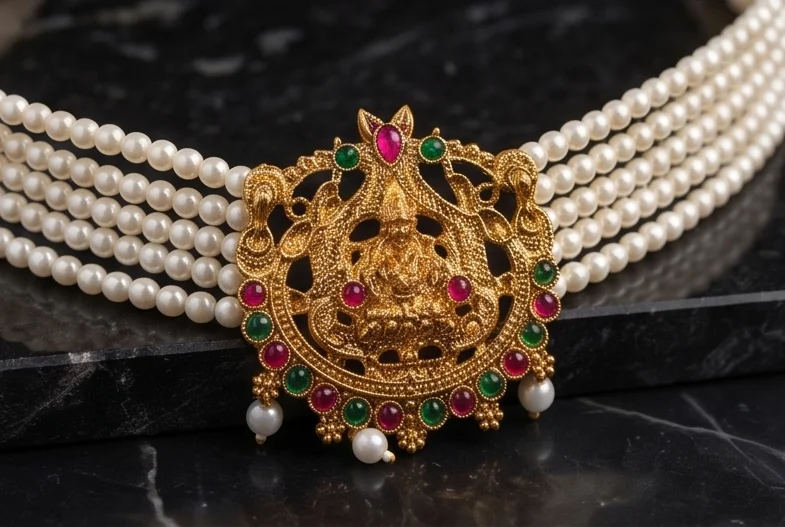
Traditional jewellery masters are carved by hand. Many factories still work that way, and skilled model makers produce beautiful work. 3D CAD adds something important for wholesale buyers: you can see and change a design precisely before any metal is cast.
What 3D CAD is
CAD (computer-aided design) software lets a designer build a jewellery piece in 3D on screen. At Jagruti we use Rhino with Matrix and Matrix Gold, which are widely used in jewellery design. The model can be rendered as a realistic image and then produced as a master for moulding.
Benefits for wholesale buyers
1. See it before it exists. A rendered proof shows the design from any angle, with stones and finish, before tooling.
2. Exact sizing. Pendant width, chain length and earring drop can be set in millimetres. Changes are precise.
3. Faster revisions. Moving a motif, adding a stone row or thinning a section takes minutes on screen, not days at the bench.
4. Symmetry. Pairs of earrings and repeating motifs are exactly matched.
5. Consistent re-orders. The file is stored. Re-orders and variations start from the same model.
6. Variations from one base. A necklace, matching earrings and a pendant can share motifs from the same file, making coordinated sets easier.
Where hand skill still matters
CAD does not replace karigars. Casting, finishing, plating and stone setting are still hand work. The best results combine a precise CAD master with experienced hands at the bench.
What you receive
- A rendered proof (front, side, detail views)
- Revisions until you approve
- A physical sample made from the approved model
When CAD helps most
- New designs from photos or sketches
- Private label and exclusive ranges
- Coordinated sets
- Adjusting an existing design for a different market (lighter, smaller, different stone layout)
Founder Bahadur Chauhan's traditional craft and the team's CAD work meet here. See our custom design service and the CAD temple jewellery factory page.
How CAD changes the approval conversation
Without CAD, a buyer often sees a design for the first time as a physical sample, and every change means another sample. With a rendered proof, most decisions happen on screen: "make the pendant 5 mm smaller", "add one more row of pearls", "move the kemp stones closer". By the time the physical sample is made, the design is usually close to final, and the sample stage becomes a check of weight, finish and comfort rather than a redesign. For a wholesaler working to a season deadline, that saves weeks.
From CAD file to metal: how the master is made
Once a CAD design is approved, the file becomes a physical master in one of two ways:
- 3D printing in castable resin. A high-resolution resin printer builds the model layer by layer. The resin model is then cast in metal by investment casting, and that metal piece is finished by hand to become the master.
- CNC milling in wax or metal, used for some flatter designs.
The finished master is then used to make the production moulds. Because the CAD file is saved, a new master can be made again later, even years afterwards, with exactly the same dimensions.
Common CAD software in jewellery
Jewellery designers widely use Rhino with jewellery-specific plug-ins such as Matrix (now MatrixGold), along with other tools for organic sculpting. The software allows stones to be placed to exact sizes, symmetry to be perfect, and variations (a smaller version, a different stone size) to be made quickly from the same file.
What CAD cannot do on its own
CAD shows shape and proportion; it cannot fully show how an antique finish will look, how heavy a piece feels, or how the stone colours will read in daylight. That is why a physical sample still matters for new bridal designs and for anything where finish and feel drive the sale. CAD reduces the number of physical samples needed; it does not remove them.
Keeping your CAD files
If you commission a custom design, agree who holds the CAD file. Having a copy on record makes future re-orders and variations easier, and supports any exclusivity or design registration you pursue.
CAD proofs: how to review them
A rendered proof is a picture of the design, often shown from several angles. When reviewing it, check proportions (is the pendant the right size against the chain?), stone sizes and positions, symmetry, and how the piece will sit when worn. Ask for measurements on the render. Comments made at this stage cost almost nothing to act on; the same change after the mould is made costs time and money.