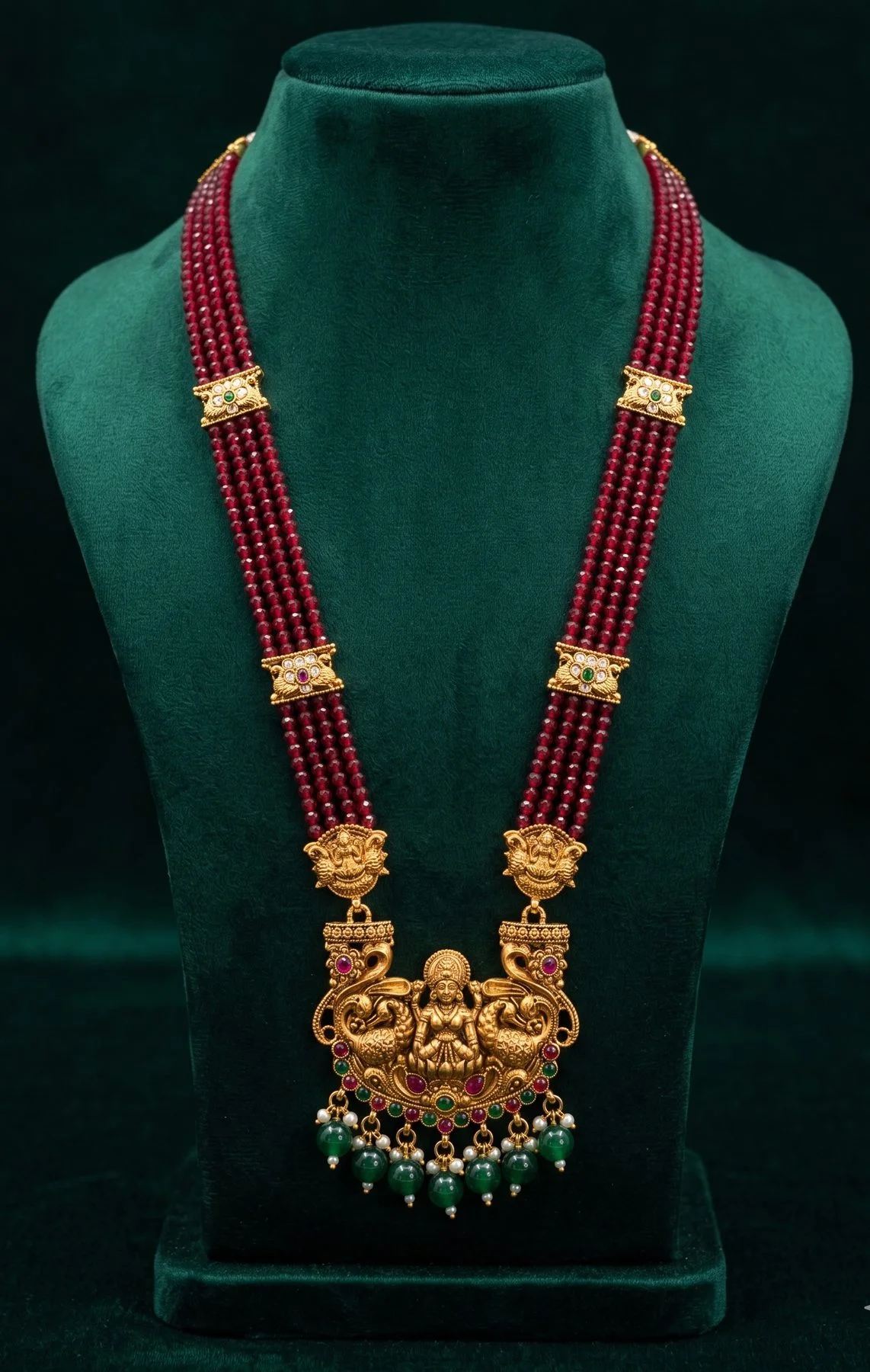
A customer buying a wedding saree or lehenga almost always needs jewellery to go with it. If your store sends her elsewhere for that, you lose the sale and some of the relationship. Many saree shops, lehenga stores and ethnic boutiques now carry a matching jewellery range, and it is one of the easiest ways to raise the value of each sale.
Why it works
- Same customer, same moment: she is already deciding on her look.
- Styling help: your staff can match jewellery to the outfit on the spot.
- Higher bill value: a jewellery set adds meaningfully to a saree sale.
- Repeat visits: customers come back for pieces to match new outfits.
Choosing styles by what you sell
| If you sell | Stock jewellery like |
|---|---|
| Silk sarees (Kanjeevaram, Mysore silk) | Temple and kemp sets, jhumkas, antique gold |
| Banarasi sarees | Kundan, polki-look, antique gold |
| Paithani and nauvari | Nath, thushi, kolhapuri saaj, traditional sets |
| Bridal lehengas and party wear | Kundan, polki-look and AD bridal sets, chandbalis, tikkas |
| Cotton and handloom | Oxidised and tribal-inspired pieces |
| Kurtis, Indo-western and fusion wear | Oxidised jhumkas, minimal pieces, AD, rose gold and statement earrings |
Buy jewellery the way you buy fabric: in the colours and styles your customers already choose.
Start small, choose well
Begin with a curated range: a few bridal sets, several festive sets, and a good selection of earrings and bangles. Display them next to the outfits they match. Track what sells for two or three months, then expand.
Stock levels
Earrings and bangles move fastest and should be restocked often. Bridal sets are slower but higher value; keep a few heroes rather than many thin designs.
Sourcing
For a first range, buy from a wholesaler with ready stock in small quantities. Once you know your bestsellers, and if you sell hundreds of pieces per design, buying direct from a manufacturer improves margin and lets you create coordinated, exclusive designs. Textile wholesalers can also offer coordinated jewellery to their own retail buyers.
Display tips
- Put jewellery beside the outfit it matches, not in a separate corner.
- Use neck forms and trays that show pieces clearly.
- Keep a mirror nearby for trying on.
Common mistakes
Stocking random jewellery that does not relate to the outfits you sell, or crowding too many designs into a small display. A small, well-matched range sells better than a large, unrelated one.
The numbers behind adding jewellery
A saree or boutique store already pays for rent, staff and footfall. Jewellery uses a small corner of that space and sells to customers who are already in the shop. Suppose a store adds a jewellery counter with stock worth Rs 1,50,000 at cost and sells it at an average markup of 80% on cost. If that stock turns over three times a year, the counter brings in about Rs 3,60,000 of gross profit a year from a space that might hold one saree rack.
The real advantage is the attach rate: the share of outfit customers who also buy jewellery. Even one customer in five adding a pair of jhumkas or a set lifts the average bill noticeably. Track it from the first month.
Legal basics for packaged retail jewellery
If you sell jewellery in retail packs with a printed MRP, India's Legal Metrology (Packaged Commodities) Rules generally expect the pack to show the maximum retail price, the name and address of the manufacturer or packer, the quantity, the month and year of packing and consumer care contact details. Ask your supplier whether their retail packs carry these, or print compliant labels yourself.
Training your team to sell the look
Your sales staff already know fabrics and outfits; jewellery is a short step from there. Teach them to suggest one piece that completes each outfit sale, not a whole range. A customer buying a green silk saree for a wedding is often happy to be shown one temple necklace set in green kemp and one pair of matching jhumkas.