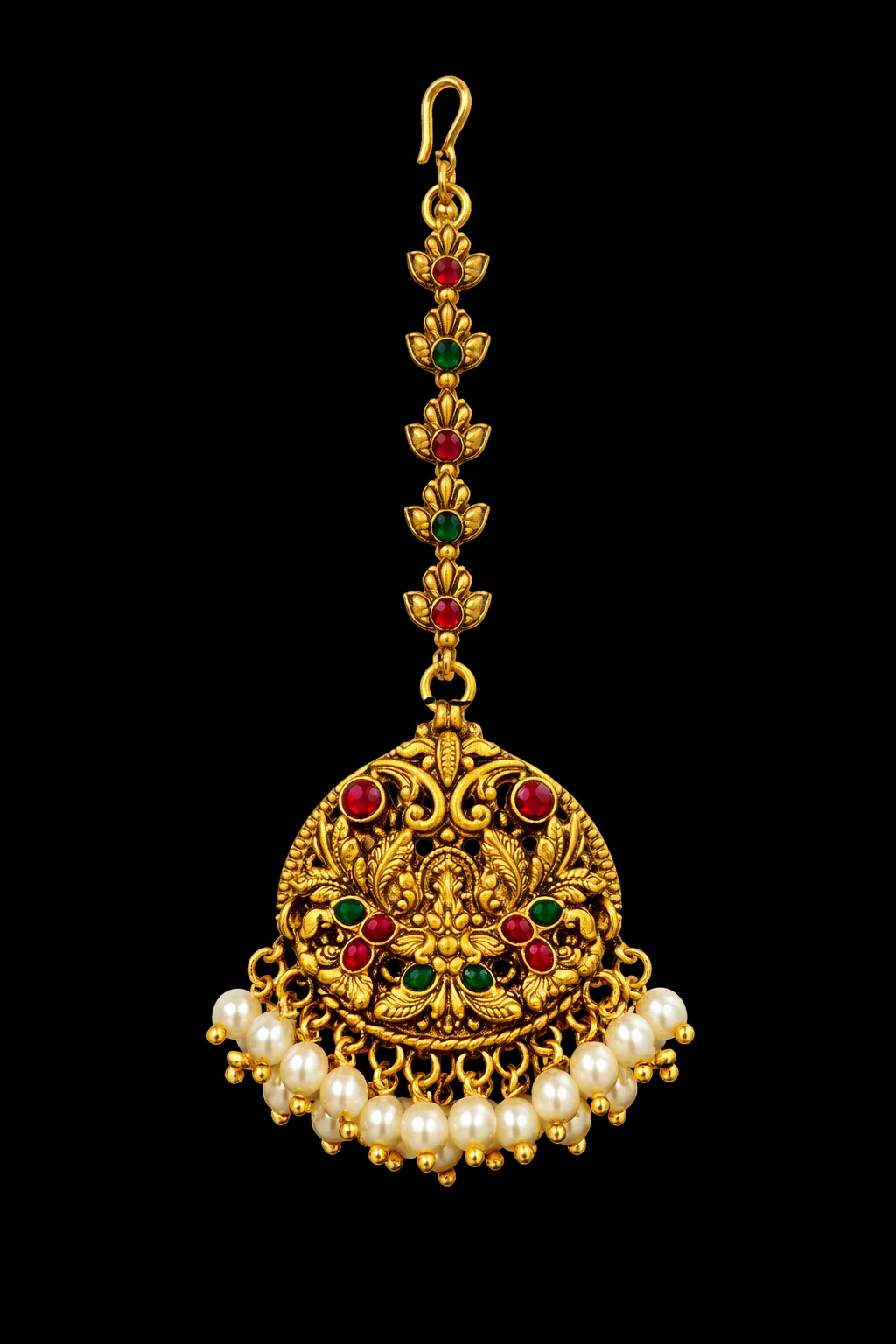
Kemp stone, in the imitation jewellery sold today, is coloured glass. It is cut, polished and set by hand to imitate the rubies and emeralds of traditional South Indian temple jewellery. The word comes from the Kannada and Telugu word kempu, meaning red, because the classic kemp colour is a deep ruby red. Green (emerald-look) and white are the other common kemp colours.
A short history
In the temple jewellery of Tamil Nadu and Karnataka, craftsmen set real rubies, emeralds and uncut diamonds into gold, often in pieces made to adorn deities and later worn by dancers and brides. As demand grew and gold became costlier, the stones were replaced first with lower-grade gems and then with glass. Today, almost all kemp jewellery sold at mass and wholesale level uses glass kemp, and it is sold honestly as imitation.
How kemp stones are made
- Glass melting: coloured glass is produced with metal oxides giving the red or green.
- Cutting: the glass is cut into small shapes: round, oval, pear, marquise, square and custom.
- Polishing: the top is polished to a smooth, slightly domed or faceted face.
- Foil or backing: many kemp stones get a reflective backing so they glow when set in a closed setting.
- Grading by colour and size so a single design uses stones that match.
How kemp stones are set
Kemp is usually set in a closed (bezel) setting: the stone sits in a cup of metal and the edges are pressed or the stone is fixed in place. Closed settings hide the stone's back and make the colour look deeper. In imitation work the metal is Mazak or brass with antique gold plating, and many stones are fixed with adhesive then framed by the metal edge.
Kemp stone vs other stones
| Stone | Material | Look | Typical use |
|---|---|---|---|
| Kemp | Coloured glass | Deep, flat glow, closed setting | Temple, South Indian bridal |
| CZ / AD | Cubic zirconia (lab-made crystal) | Bright sparkle, faceted | AD sets, cocktail, modern bridal |
| Polki-look | Glass or uncut CZ with foil | Soft, uncut diamond look | Polki and Kundan sets |
| Kundan | Glass with gold foil | Framed glass in gold foil | North Indian bridal |
For a deeper comparison for resellers, read kemp vs CZ vs polki.
Where kemp work comes from
The best-known centre of South Indian temple jewellery is Nagercoil in Kanyakumari district, Tamil Nadu, and especially the Vadasery area, where families of craftsmen have made it for generations. The temple jewellery of Nagercoil carries a Geographical Indication (GI) tag. Traditionally, craftsmen shaped silver, overlaid it with thin gold sheet and set red and green stones (called kuchu kal) in lac (arakku), a natural resin that holds the stones and gives a slightly raised, glowing setting.
Today's imitation kemp jewellery follows the same visual language, the same motifs (Lakshmi, peacocks, lotus, mango, temple towers) and the same red-green colour scheme, but uses cast base metal, plating and glass stones so that it can be made in volume at an accessible price.
Kemp colours and what they are called
| Colour | Imitates | Common use |
|---|---|---|
| Deep red (kempu) | Ruby | The main stone in almost every design |
| Green (pachai) | Emerald | Accents, borders, parrot and leaf motifs |
| White | Diamond or white sapphire | Borders, small highlights |
| Pink and blue | Pink sapphire, sapphire | Occasional, fashion versions |
Most retail demand is for red with green accents. All-red sets are popular for dance and temple wear, and green-dominant sets sell to customers matching them with red silk sarees.
Kemp and dance jewellery
Bharatanatyam and Kuchipudi dancers wear kemp temple jewellery as part of the costume: long and short necklaces, waist belt, armlets, earrings, nethi chutti with sun and moon pieces, and hair ornaments. Dance sets need secure fittings and consistent colour across a group of students. See our classical dance jewellery page.
How to judge kemp quality in bulk
- Colour match: all stones of one colour in a piece should match. Mismatched reds are the most common defect.
- Seating: stones should sit flush, not tilted, with no glue visible around the edge.
- Surface: no chips, scratches or bubbles on the face.
- Metal edge: the frame should grip the stone evenly.
What this means for your counter
Customers buying kemp jewellery want the look of traditional temple gold with red and green stones, at a fraction of the price. As long as the pieces are sold honestly as imitation, glass kemp is exactly what they are paying for. The quality difference between suppliers is in the colour matching, setting and plating, not in whether the stone is glass.
We make kemp jewellery in bulk at our Mumbai factory. See our kemp jewellery wholesale page for the range.