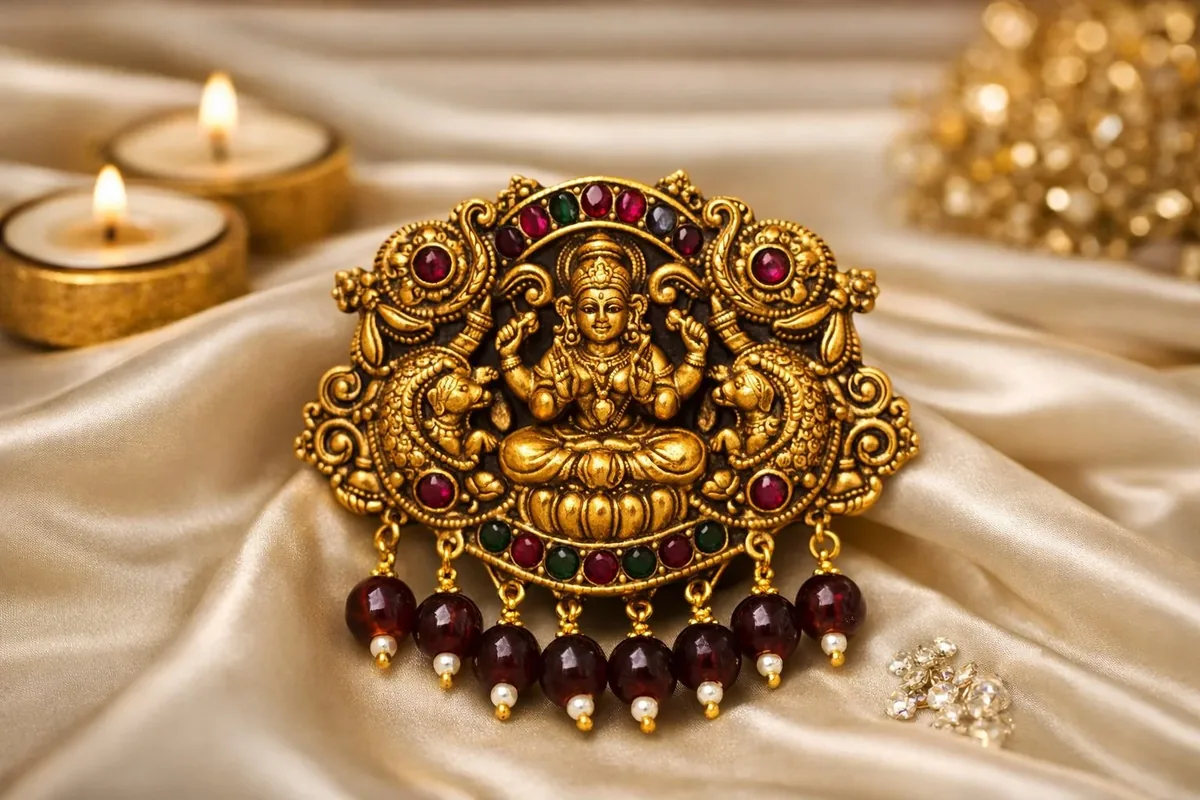
When you order a new design, part of what you pay for is invisible in the finished piece: the mould. Understanding mould costs explains why MOQs exist and why a new design costs more per unit at small quantities.
Why moulds are needed
Imitation jewellery is cast. Molten Mazak or brass is poured or spun into a mould to form each piece. The mould is made from a master model. One design can need several moulds if it has separate parts, such as a pendant, side motifs and a clasp.
Types of moulds
- Rubber moulds: common for spin-casting zinc alloy. Flexible, good for detail.
- Metal moulds: for high-volume die-casting. Costlier to make, very durable.
The choice depends on the design, metal and expected volume.
What goes into mould and setup costs
- CAD modelling or hand-carved master
- Producing the master
- Making the mould or moulds
- Trial castings and adjustments
- Sample production
These are fixed costs per design. They do not grow with quantity, so they weigh heavily on small runs and lightly on large ones.
How mould cost affects unit price
| Quantity per design | Effect of fixed costs per unit |
|---|---|
| Small run | High share of unit price |
| At MOQ | Reasonable share |
| Large run | Small share |
This is why our MOQ is 200 pcs per design (400 for earrings and pendants): it keeps unit prices fair.
Ways to keep mould costs down
- Use existing designs from the catalogue where possible.
- Modify, not reinvent: changing stone colours or finish on an existing mould costs far less than a new mould.
- Share components: use the same pendant or motif across several designs.
- Order deeper on fewer new designs.
- Plan re-orders: once a mould exists, re-orders do not pay for it again.
Who owns the mould?
Discuss this for exclusive and private label designs. Ownership and exclusive use affect whether the factory can sell the design to others. Read exclusive designs for wholesalers.
Rubber moulds, silicone moulds and steel dies
| Mould type | How it is made | Life | Best for |
|---|---|---|---|
| Vulcanised rubber | Master packed in rubber sheets, cured under heat and pressure | Many casting cycles, then wears | Spin casting of zinc alloy, most imitation jewellery |
| RTV silicone | Poured liquid silicone, cured at room temperature | Fewer cycles; gentler on delicate masters | Short runs, resin or wax models |
| Steel die | Machined steel tool | Very long | Pressure die casting for very large runs of one design |
Most imitation jewellery uses rubber moulds for spin casting, because they cost far less than steel dies and suit the quantities involved. A complex set may need several moulds: one for the pendant, one for the chain links, one for the earrings and one for small fittings.
Why a "free" mould is not free
Some suppliers say they charge nothing for moulds. The cost has not disappeared: it is spread into the unit price, often assuming a certain quantity. If you then order fewer pieces than assumed, the factory recovers less than it spent, which is why MOQs exist. Understanding this helps you compare quotes: a supplier who charges a separate mould fee and a lower unit price can be cheaper overall on a large order.
Moulds wear out
A rubber mould gradually loses sharpness after many cycles, and fine detail starts to soften. For a design you re-order for years, the factory will eventually make a new mould from the saved master or CAD file. Ask whether the master is kept safe; without it, a worn mould cannot be replaced exactly.
Re-using moulds for variations
A single mould can often produce several versions of a design: different stone colours, different finishes or different pearl drops. Planning variations around an existing mould is the cheapest way to widen a range.
A worked example
Suppose a custom pendant needs a design charge and moulds that together cost the factory Rs 15,000, and each pendant then costs Rs 90 to make.
| Quantity | Design and mould cost per piece | Making cost per piece | Total per piece |
|---|---|---|---|
| 100 | Rs 150 | Rs 90 | Rs 240 |
| 400 | Rs 37.50 | Rs 90 | Rs 127.50 |
| 1,000 | Rs 15 | Rs 90 | Rs 105 |
The figures are only an illustration, but they show why a custom design at low quantity is expensive per piece, and why factories set higher minimums for small items like pendants and earrings. If a custom design is going to be a long-running seller, a larger first order, or a commitment to re-orders, brings the per-piece cost down sharply.