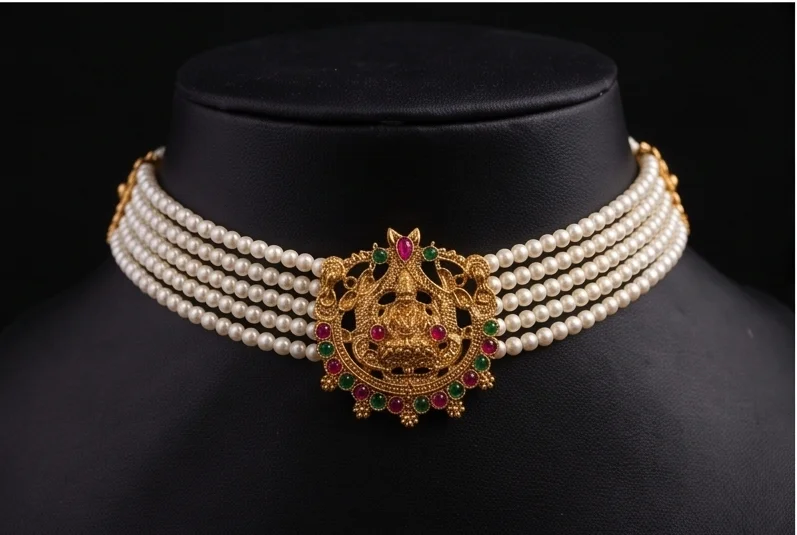
If you have picked up an imitation necklace and read "Mazak base" on the tag, you have met the most common base metal in Indian fashion jewellery. Mazak (also written Mazac, and known internationally as Zamak) is a family of zinc alloys. The name comes from the metals in it: zinc plus small amounts of aluminium, magnesium and copper. In a typical die-casting grade, zinc makes up around 95% of the metal, aluminium about 4%, and the rest is magnesium with a little copper.
For a wholesaler or retailer, knowing what Mazak is matters because it decides how a piece feels in the hand, how sharp the design looks, how well the plating holds, and what it costs.
What Mazak material means in plain terms
Mazak is a low-melting, free-flowing metal. It melts at roughly 380 to 390 degrees Celsius, far lower than brass, which means it can be pushed into detailed moulds quickly and cheaply. When it cools, it keeps fine detail: filigree lines, deity faces, tiny beads and textured backgrounds come out crisp. That is exactly what imitation jewellery needs, because the finish we see as "gold" is only a few microns of plating over this casting.
In the trade you will hear it called zinc alloy, Mazak, "white metal" (loosely) or simply "alloy". They mostly mean the same thing, although "white metal" is also used for tin-based alloys, so ask your supplier which one they mean.
How Mazak is used in jewellery manufacturing
At a factory like ours in Kandivali East, Mumbai, a Mazak piece goes through these stages:
- Master model: made by hand or in 3D CAD (we use Rhino with Matrix), then cast as a master.
- Mould: a rubber or metal mould is made from the master.
- Casting: molten Mazak is poured or spun into the mould.
- Cleaning and polishing: flash lines are removed and the surface is smoothed.
- Pre-plating layers: a copper or nickel-free base layer so the final plating bonds well.
- Plating: antique gold, matte gold, high-polish gold, rhodium or oxidised finish.
- Stone setting and finishing: kemp, CZ, pearls or beads are set, then the piece gets an anti-tarnish coat.
Mazak vs brass: the short version
| Factor | Mazak (zinc alloy) | Brass |
|---|---|---|
| Weight | Lighter | Heavier |
| Detail | Very sharp | Good |
| Cost | Lower | Higher |
| Plating bond | Good with proper base layers | Excellent |
| Feel | Modern, lighter wear | Traditional, heavy |
We cover this in depth in Mazak vs brass for imitation jewellery.
Mazak grades: Zamak 3, Zamak 5 and why purity matters
"Mazak" is a family of alloys, not one recipe. The two grades most used for small castings are:
| Grade | Aluminium | Copper | Magnesium | Notes |
|---|---|---|---|---|
| Zamak 3 | about 4% | very little (up to about 0.25%) | a trace, about 0.02 to 0.05% | The most common die-casting grade; good fluidity and stable size |
| Zamak 5 | about 4% | about 1% | a trace | Around 10% stronger and harder than Zamak 3 |
The magnesium is small but important: it helps stop a slow failure called intergranular corrosion, where moisture attacks the boundaries between the metal's grains. That failure is triggered by impurities, above all lead, tin and cadmium. Standards for die-casting alloys keep those three at tiny levels for exactly this reason.
This is why the source of the metal matters so much. Castings poured from clean, graded alloy ingot stay stable for years. Castings poured from mixed scrap, old fittings and unknown remelt can look perfect when new, then swell, crack or crumble at thin sections after a season or two in a humid shop. When you ask a supplier "which base metal?", follow up with "from graded ingot or from scrap?"
Weight, feel and melting point compared with brass
Zinc alloy has a density of roughly 6.6 to 6.7 grams per cubic centimetre, against roughly 8.4 to 8.7 for brass. The same design cast in brass therefore weighs about a quarter to a third more. Brass also melts at around 900 degrees Celsius or more, against roughly 380 to 390 for Mazak, which is a large part of why brass castings cost more to make.
How Mazak jewellery is cast
Two methods dominate:
- Spin (centrifugal) casting into vulcanised rubber or silicone moulds. The mould spins and throws the molten alloy into every recess. It suits jewellery well: moulds are cheap to make, so short runs of a new design are practical.
- Pressure die casting into steel dies. Very fast and very consistent, but the dies are expensive, so it pays only for long runs of one design.
Most imitation jewellery factories, including ours, use spin casting for the bulk of their range.
Is Mazak safe and durable?
A properly plated and lacquered Mazak piece is durable for normal wear. The weak points are bending (zinc alloy is more brittle than brass, so thin parts can snap if forced) and moisture (if the plating is scratched through, the zinc underneath can dull). Good manufacturers design thicker sections where pieces flex, such as hooks and joints, and finish with an anti-tarnish coat.
On skin safety, what matters most is the finish layer and whether nickel is used under the plating. If you sell into markets with strict rules, such as the EU, ask for nickel-free processing in writing.
Why wholesalers should care
For a distributor or chain retailer, Mazak is the reason large, detailed imitation pieces can sell at accessible retail prices. A heavy temple haaram in brass costs noticeably more to make than the same design in Mazak. Most buyers choose by segment: Mazak for detailed, lighter, price-sensitive ranges, and brass for heavy traditional and bridal lines where weight signals value.
If you are sourcing in bulk, ask every supplier three questions: which base metal they use, whether they apply a base layer before plating, and whether they seal with an anti-tarnish coat. The answers tell you more about the piece than any catalogue photo.