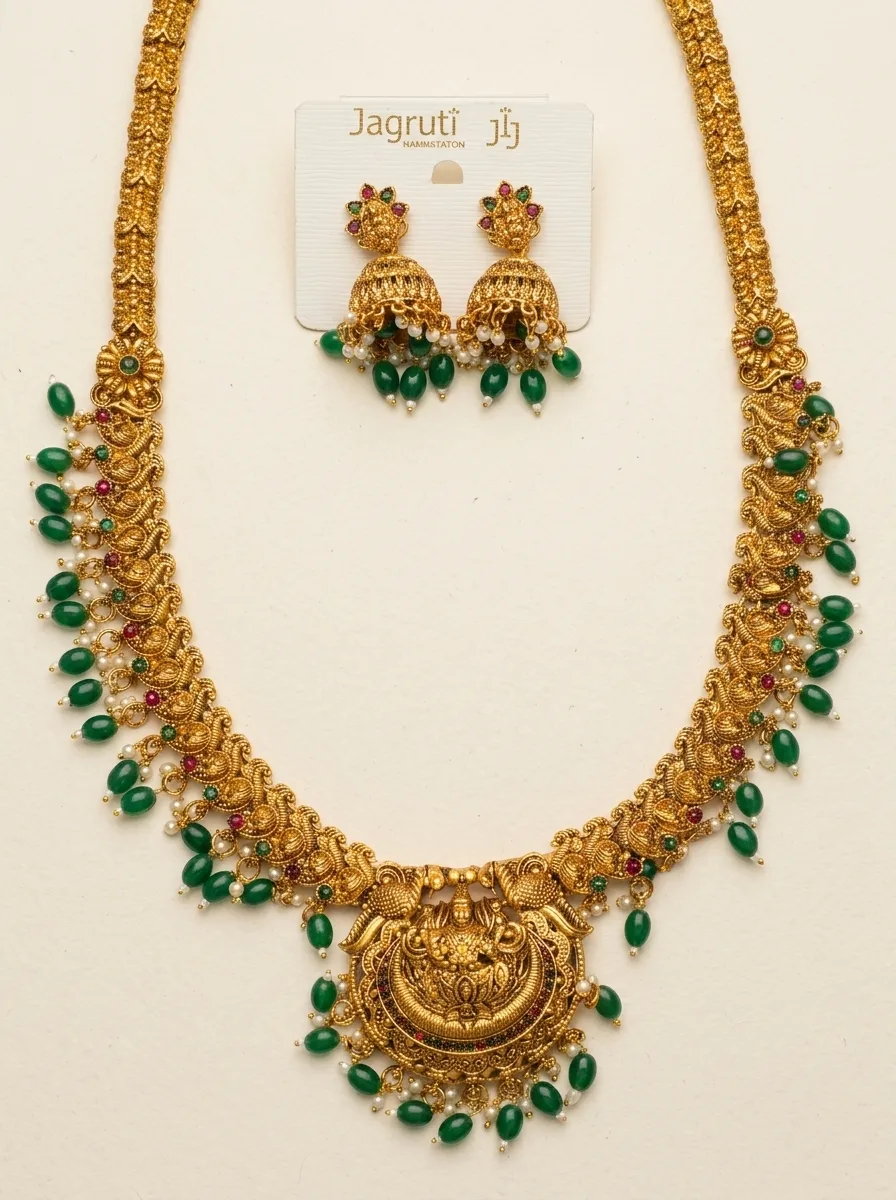
Maharashtrian jewellery has a look all its own: the curved pearl nath, the gold-bead thushi hugging the neck, the long kolhapuri saaj and green glass bangles with gold-tone patlis. Brides wear it with the nauvari (nine-yard) saree, and women across the state wear lighter versions for festivals. For wholesalers serving Maharashtra and the Marathi diaspora, it is a distinct range that does not substitute for anything else.
The key pieces, and what they mean
- Nath: the curved nose ring with pearls framing a central red or green stone, in Brahmani and Peshwai shapes. Worn by brides and at festivals such as Gudi Padwa and Ganeshotsav; for many customers it is the single piece that says "Maharashtrian".
- Thushi: a close choker of tightly packed small gold beads, originally from the Kolhapur region, worn with a dori tie, often with a small pendant.
- Kolhapuri saaj: a necklace of leaf-shaped and symbolic pendants, traditionally 21 of them, given to brides; each pendant carries a meaning such as prosperity or protection.
- Tanmani: a pearl necklace with a pendant, often with rubies and emeralds.
- Chinchpeti: a pearl choker with a gold-tone lattice, named after the tamarind-seed shape of its motifs.
- Mohanmal: a necklace of hollow gold beads, strung in several layers.
- Putali haar: a necklace of coins.
- Bugadi: an ornament worn on the upper ear.
- Patli and tode: gold-tone bangles worn with green glass bangles.
- Vaki: an armlet worn on the upper arm.
Knowing these meanings helps retailers sell the story along with the piece.
Occasions and seasons
| Occasion | What customers look for |
|---|---|
| Wedding | Full set: nath, thushi, saaj or mohanmal, bangles, vaki |
| Mangalagaur and Haldi-Kunku | Lighter traditional sets, nath and thushi |
| Gudi Padwa and Ganeshotsav | Nath, chinchpeti, thushi for the nauvari look |
| Navratri and Diwali | Festive sets |
| Office and daily wear | Small thushi-style chokers and mini naths |
Because families buy nath and thushi for Gudi Padwa and cultural events, not only weddings, demand is spread through the year. The nauvari (nine-yard) saree look has become popular for weddings, festivals and photoshoots, and it drives demand for traditional pieces even among customers who do not wear them otherwise.
What sells in imitation
Many Maharashtrian families own some of these pieces in gold. Imitation versions sell for occasions where families prefer not to wear heavy gold, for younger customers styling the traditional look, and for the pieces a family does not own in gold - so a convincing gold tone and crisp bead work matter, because customers compare with family pieces. The nath and thushi are the volume leaders; clip-on naths are especially popular, because many women do not have pierced noses or want a larger nath for a festival. Kolhapuri saaj and tanmani sell as bridal and festive pieces, and patli sets sell alongside green bangles.
Quality points
| Piece | What to check |
|---|---|
| Nath | Pearl alignment, clip comfort, secure stone |
| Thushi | Even beads, flexible fit, secure clasp |
| Kolhapuri saaj | Uniform pendants, even spacing |
| Tanmani and chinchpeti | Pearl quality, pendant finish |
| Patli | Smooth inside, correct sizes |
Finish
Maharashtrian pieces are often made in a bright or slightly antique gold with pearls and red and green stones. Matte finishes suit modern brides. Keep finishes consistent across a set, since customers often buy nath, thushi and saaj together.
A starter range, and stocking tips
| Piece | Designs to start with | Why |
|---|---|---|
| Naths | 4 to 6, clip-on and pierced, in two or three sizes | The signature piece; brides want large naths, festival buyers smaller ones |
| Thushi chokers | 3 to 4, adjustable to fit more necks | Weddings, festivals, nauvari looks |
| Saaj and mohanmal | 2 to 3 each | Bridal and Mangalagaur |
| Bangles (tode, patli) | 3 to 4 sets | Complete the look |
Build complete sets (nath, thushi, saaj, earrings) for brides, and expand from what sells in the first season. The common mistakes: naths in only one size, bright yellow plating where customers expect a traditional gold tone, and missing Gudi Padwa and Ganeshotsav, two of the strongest selling periods.
Beyond Maharashtra
Marathi communities in Gujarat, Karnataka, Goa, Madhya Pradesh and abroad also buy these pieces, often from Mumbai. Exporters serving the diaspora can include Maharashtrian sets in their range.
Working with a Mumbai factory
Being based in Mumbai, we know these designs well and make them to order at 200 pcs per design (400 for earrings and pendants). See bridal jewellery manufacturer and read nath and nose ring wholesale.