Price too high and pieces sit; too low and you leave money on the table or look cheap. Good pricing combines cost, market and customer perception.
Start with landed cost
Know your true cost per unit: factory price, transport, packing, and an allowance for breakage and slow stock. Read calculating margins.
Check the market
What do similar pieces sell for in your area and online? Customers compare. Your price must make sense against alternatives.
Build a price ladder
Offer clear tiers in each category:
| Tier | Purpose |
|---|---|
| Entry | Impulse and budget buyers |
| Core | Most of your sales |
| Premium | Bridal and hero pieces |
A ladder lets customers trade up and makes your premium pieces look worth it.
Price for perceived value
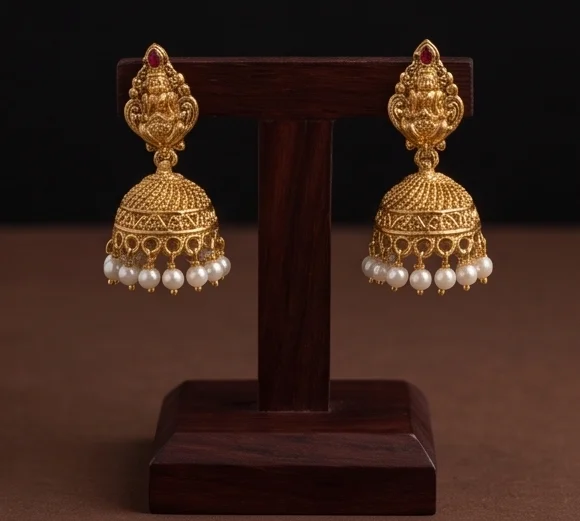
Pieces that look richer than their cost, such as detailed antique or kemp work, can carry higher MRPs. Presentation (packaging, display) also affects what customers will pay.
Customers judge imitation jewellery by look, weight and presentation, not by cost. A heavy, detailed temple set in good packaging can carry a strong price; a light piece with a thin finish cannot, however cheap it was to buy. When setting prices, look at each piece as a customer would, and price it against what similar-looking pieces sell for in your market.
Leave discount room
Indian customers often expect some discount, especially in traditional markets and at festivals. Build it into MRP rather than eating your margin.
Keep pricing consistent
Across branches and online, the same design should have a consistent price. Inconsistency erodes trust.
Common mistakes
Pricing by guesswork, forgetting transport and slow-stock costs, and cutting prices on bestsellers that would sell anyway.
An example
A necklace set with a landed cost of 100 might sit at a core MRP of around 250 to 300 in a boutique, with a matching premium version at a higher tier and an entry version with fewer stones at a lower one. Actual multiples vary by market and channel.
See how wholesale pricing works.
Pricing new designs
For a new design with no sales history, price it within the tier of similar pieces, then review after a few weeks. If it sells out quickly, the price may be too low; if it sits while similar pieces sell, it may be too high or poorly displayed.
Festival pricing
Many retailers keep regular prices during festivals and offer value through bundles instead of discounts, protecting margin while still giving customers a reason to buy.
A worked price ladder
Suppose you stock jhumkas at four factory prices. A sensible retail ladder might be:
| Tier | Landed cost | Retail price | Markup on cost |
|---|---|---|---|
| Entry | Rs 60 | Rs 149 | About 150% |
| Standard | Rs 110 | Rs 249 | About 125% |
| Premium | Rs 180 | Rs 399 | About 120% |
| Statement | Rs 300 | Rs 649 | About 115% |
Lower tiers often carry a higher percentage markup because the absolute margin is small and handling costs per piece are the same. Prices ending in 49 or 99 are common in Indian fashion retail, but consistency across your range matters more than any single price ending.
MRP and discounts
The MRP printed on a pack is the maximum you can charge, including taxes. Setting MRP too high to allow constant "discounts" can damage trust once customers compare prices elsewhere. Set an MRP you are comfortable selling at, and keep discounts for genuine events.
Pricing online vs in store
Online prices must cover platform commission, shipping and a higher rate of returns. Many sellers keep online prices slightly higher than in store, or offer different designs online to avoid direct comparison.
Reviewing prices each season
Metal and labour costs change, so factory prices move over time. Review your retail prices at the start of each season, compare them with competitors, and adjust tiers rather than individual pieces. Customers accept gradual changes across a range more easily than sudden jumps on familiar items.
Pricing sets vs separates
When you sell both sets and separate pieces from the same design family, price the set slightly below the total of its pieces bought separately. Customers see value in buying the full set, and your average sale rises. Keep the separate pieces available at full price for customers who only need one item.