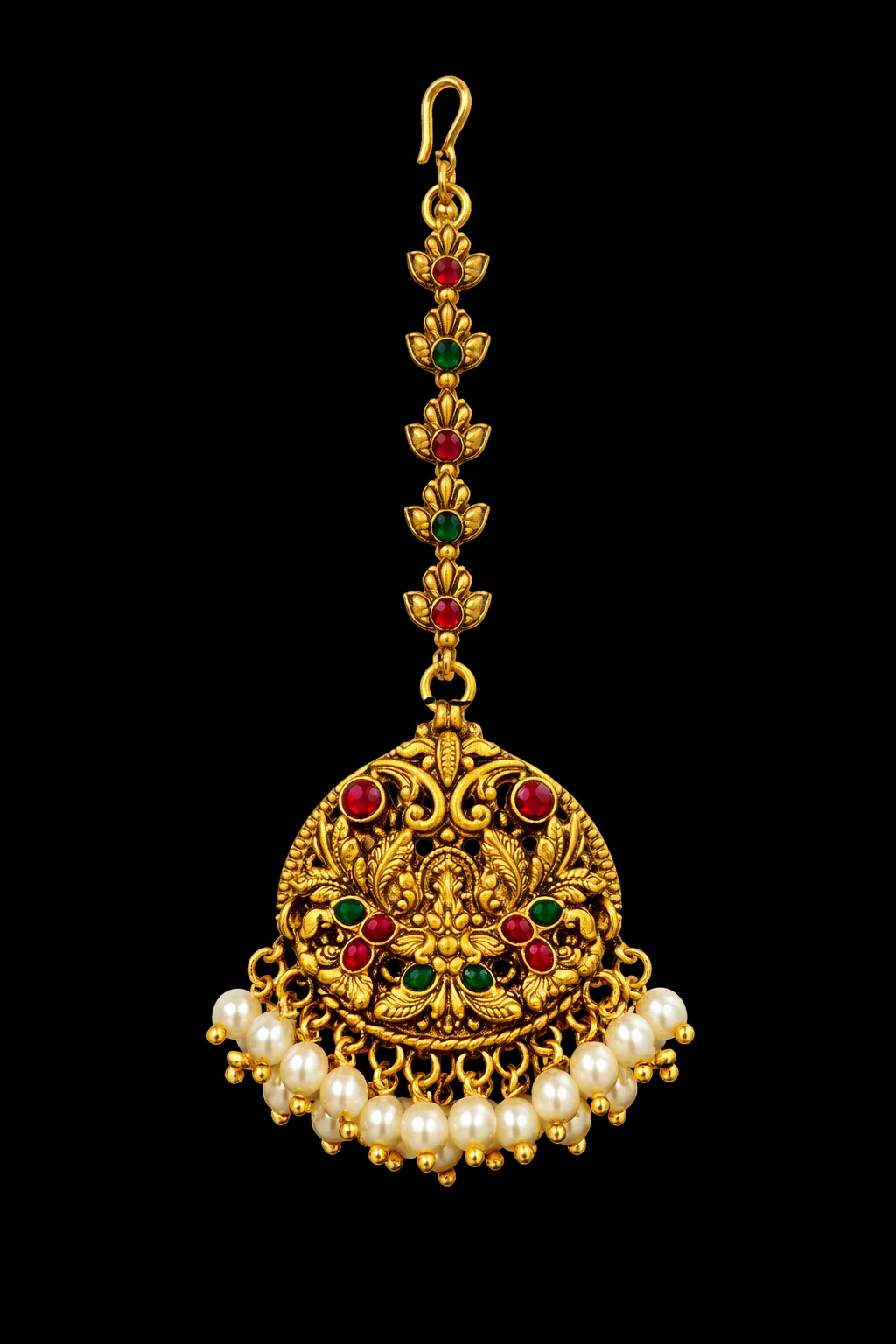
Temple jewellery is one of the most dependable categories for South Indian retail and for diaspora exporters. It is also one of the most detailed to manufacture, so buying it well depends on knowing what to look for.
Key pieces and their names
| Piece | What it is |
|---|---|
| Long haaram | Long necklace with a large deity or peacock pendant |
| Kasu mala / kasulaperu | Long necklace of Lakshmi coins |
| Manga malai / mango mala | Long necklace of mango-shaped motifs |
| Attigai / addigai | Broad choker, often heavy with kemp |
| Oddiyanam / vaddanam | Waist belt |
| Vanki | Armlet with a V shape, worn on the upper arm |
| Nethi chutti | Forehead ornament on a central chain |
| Surya and chandra | Sun and moon hair pieces for dance and bridal |
| Jada billai / jada nagam | Plait ornaments |
| Jhumka, chandbali and mattal | Bell and crescent earrings, and the ear chain to the hair |
Bangles and rings complete the range. A complete South Indian bridal or dance look uses most of these; retailers who can supply a full set from one supplier, in matching finish and stones, have an advantage.
Motifs that sell
Lakshmi is the most popular, followed by Ganesha, Krishna, peacock, lotus, swan (hamsa), elephant and temple gopuram designs. Regional buyers have favourites: Guttapusalu pearl clusters in Andhra and Telangana, heavy kemp in Tamil Nadu, lighter designs in Kerala and Karnataka.
Finishes and stones
Temple buyers expect an antique gold finish: warm, slightly darkened, with bright highlights on raised details like the deity's face and crown. A bright yellow finish looks cheap next to real temple gold. Matte gold suits modern temple designs. Stones are usually kemp (ruby and emerald glass), pearls, and sometimes CZ accents. Ask for the antique tone to be recorded against the approved sample, so repeats match.
Quality checklist
| Check | Why |
|---|---|
| Sharp deity faces and details | Worn moulds or poor casting blur the details that make temple jewellery convincing |
| Even antique tone | Some pieces much darker than others in a batch look dirty |
| Matched kemp colours | Mismatch is the most common flaw |
| Kemp seated firmly | Stones at the edges of large pendants loosen first |
| Secure pearls and hangings | They catch on fabric |
| Strong hooks and screws | Heavy haarams and chokers stress findings |
| Anti-tarnish packing | Protects in humid regions |
Check a sample of each design for these before accepting a batch.
Seasons
Temple demand follows South Indian wedding dates (muhurtham seasons), Varalakshmi Vratham, Navaratri, Deepavali, Pongal and Onam in Kerala. Dance schools add demand around arangetrams and annual shows. Order new designs well before these peaks.
Base metal choice
Mazak (zinc alloy) gives sharp detail and lighter weight at a lower cost. Brass gives heavier, traditional weight. Many buyers choose Mazak for detailed pendants and brass for pieces that flex, such as bangles. Read Mazak vs brass.
Working with a temple jewellery manufacturer
Share reference photos with motif, size, finish and stone colours. Approve a CAD proof and physical sample. Order at MOQ per design. At Jagruti, founder Bahadur Chauhan has over 30 years in temple jewellery craft, and our MOQ is 200 pcs per design (400 for earrings and pendants) with 60/40 terms and video approval.
See temple jewellery wholesale or read the Guttapusalu haaram.
Where temple jewellery comes from
The tradition is strongly linked with Tamil Nadu, and especially with Nagercoil in Kanyakumari district, whose temple jewellery carries a Geographical Indication tag. Traditional pieces were made in gold, or gold over silver, with red and green stones set in lac. Imitation temple jewellery keeps the motifs, colours and shapes, using plated base metal and glass stones so it can be sold at a fraction of the price.
Stocking for dance schools
Bharatanatyam and Kuchipudi schools buy complete dance sets every year for new students and for arangetrams. Dance sets need secure fittings, lighter weight for movement and consistent colour across a group. It is a steady niche worth building relationships with.