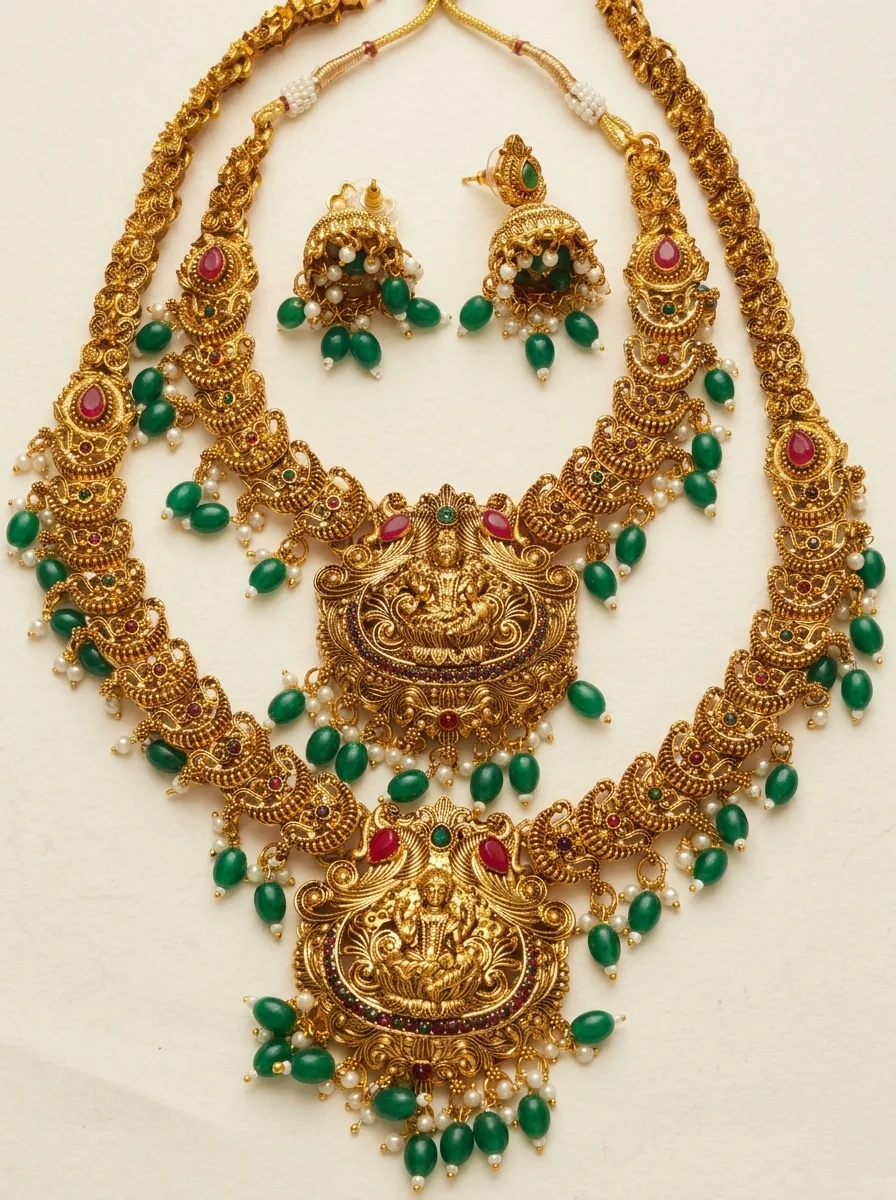
The rani haar, literally "queen's necklace", is a long, often layered necklace that falls below the chest. In North Indian bridal wear it is the statement piece paired with a choker. For wholesalers, rani haars are high-value, lower-volume pieces that lift the whole bridal range.
What a rani haar is, and the styles that sell
A rani haar ("queen's necklace") is a long necklace that falls to mid-chest or below, often in several strands or layers, usually with a large central pendant or a series of motifs. It is a statement piece for weddings and major functions, associated with the royal jewellery of Rajasthan and the courts of North India, and today worn across India.
- Kundan rani haar: multiple layers of Kundan with pearls and drops.
- Polki-look rani haar: uncut stone effect for Mughal-style bridal.
- Temple long haar: the South Indian equivalent, with deity pendants.
- AD rani haar: long CZ layers for receptions.
- Antique rani haar: aged gold with beads.
Classic rani haars are antique or warm gold with red and green stones. Newer demand includes pastel Kundan (mint, pink, powder blue) and pearl-heavy designs with fewer stones, which suit daytime functions and younger brides. Keep one or two classic designs as steady sellers and use the rest of the range to follow colour trends.
Layers and lengths
Rani haars come in single, double and multi-layer designs. Longer, layered pieces sell for bridal; single long necklaces sell for festive and guest wear. Consider offering the same motif in two sizes: a full bridal version and a lighter guest version.
Pairing
The classic North Indian bridal look is a choker plus rani haar. Offer both in coordinated designs so customers can buy the pair. Matching earrings and maang tikka complete the set.
Some brides add a third, medium-length necklace between them. Sell rani haars with matching chokers and earrings, or at least in finishes that match your choker range, so the layers look like one set.
Quality and construction checks
| Area | Look for |
|---|---|
| Strand spacing | Layers hang evenly without tangling |
| Pendant balance | A heavy centre pendant does not twist the necklace forward |
| Links and joins | Soldered or firmly closed - long necklaces carry weight on their links |
| Stones | Flush and matched |
| Pearls | Firmly strung, even size |
| Closure | A strong hook or dori tie with adjustable length |
| Weight | Comfortable for long functions |
Stocking, packing and display
- Rani haars are premium: stock fewer designs, but make them count.
- Pair each with a coordinating choker, and keep lighter guest versions for relatives.
- Ask your manufacturer to pack each one flat on a card or in a long box, strands separated and the pendant supported - a tangled rani haar costs counter time and can damage the piece.
- Display them hanging, not coiled in a box, so customers see the fall of the layers. Photos of the rani haar worn with a choker often turn a single-piece sale into a pair.
Seasons
Demand peaks in North Indian wedding seasons and around Karva Chauth and Diwali. Order early; multi-layer pieces take longer to make.
We make rani haars and coordinated bridal sets at our Mumbai factory at 200 pcs per design (400 for earrings and pendants). See Kundan and Polki wholesale.
Custom rani haars
When briefing a factory, give the drop length of each layer, the spacing between layers and the pendant size. Ask for the CAD proof to show the necklace on a figure, so you can judge proportions before a sample is made.