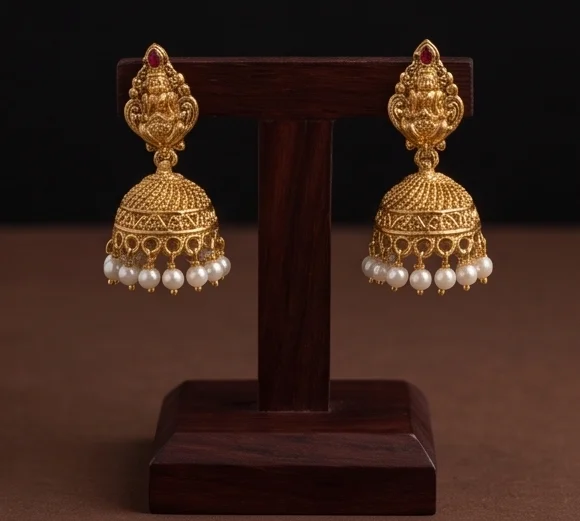
MOQ stands for minimum order quantity: the smallest order a supplier will accept. In imitation jewellery, MOQ is usually stated per design. At Jagruti, our MOQ is 200 pcs per design (400 for earrings and pendants).
Why manufacturers set an MOQ
Making a design involves fixed work before the first piece is sold:
- 3D CAD modelling or a hand master
- Moulds
- Casting setup and plating setup
- Sample making and approval
- Stone sorting and colour matching
These costs are the same whether the factory makes 20 pieces or 2,000. Spreading them over a minimum quantity keeps the per-unit price fair. Below that, either the unit price rises sharply or the factory loses money.
Per-design vs per-order MOQ
- Per-design MOQ: each design must reach the minimum. Example: 200 units of design A and 200 of design B.
- Per-order MOQ: the whole order must reach a total, however it is split. Common with traders and ready-stock sellers.
Manufacturers usually work per design, because the fixed costs are per design.
Can I mix designs?
Yes. Mixed orders are normal: several designs, each at or above 200 units. Typical first orders from our clients range from 1,000 to 5,000 units across designs.
What if my requirement is smaller?
If you need fewer than 200 units of a design, a wholesaler or trader with ready stock is the better route. That is not a judgement on small businesses; the factory model simply works at run quantities.
Planning around MOQ and cash flow
A 200-piece MOQ across five designs is 1,000 pieces, which is real money for a growing business. To manage it:
- Pick fewer, stronger designs rather than many designs at thin quantities.
- Use sell-through data from past seasons to choose volumes.
- Confirm designs in two waves: your safest best sellers first, then new designs once the first wave is selling. Use the lead time between waves to check sell-through.
- Split large orders into batches if cash flow is tight. At Jagruti, batch-wise payment is available on orders of 1,000+ units.
- Keep design codes so re-orders are exact.
See how we supply wholesalers and distributors or read about mixed-design orders.
A worked example of why MOQ exists
Imagine a new necklace design has fixed costs of Rs 20,000 before the first piece is sold: CAD and master, moulds, casting and plating setup, sample making and stone sorting. Suppose each necklace then costs Rs 150 in metal, plating, stones and labour.
| Quantity | Fixed cost per piece | Variable cost per piece | Cost per piece |
|---|---|---|---|
| 20 | Rs 1,000 | Rs 150 | Rs 1,150 |
| 100 | Rs 200 | Rs 150 | Rs 350 |
| 200 | Rs 100 | Rs 150 | Rs 250 |
| 500 | Rs 40 | Rs 150 | Rs 190 |
| 1,000 | Rs 20 | Rs 150 | Rs 170 |
The figures are only an illustration, but the shape is real. Below a certain quantity, the fixed costs make each piece uneconomic. That point is the MOQ. Above it, the price keeps falling, steeply just above the MOQ and more slowly at higher volumes. For your best sellers, it can be worth ordering well above the minimum; for new or experimental designs, stay close to the MOQ until you see how they sell.
Why earrings and pendants have a higher MOQ
Earrings and pendants are smaller and quicker to make per piece, so the same fixed cost has to be spread over more units to make a run worthwhile. That is why our MOQ is 400 for earrings and pendants and 200 for necklaces, chokers, haarams and sets.
Questions to ask any supplier about MOQ
- Is the MOQ per design, per colour or per order?
- Can one design be split across two stone colours within the MOQ? Sometimes it can, when the mould is the same - ask when you order.
- Is the MOQ the same for re-orders?
- Is there a price break at higher quantities?
MOQ on re-orders
Re-orders of existing designs usually follow the same MOQ, but lead times are shorter because moulds and settings already exist. Keep a record of the design code, finish and stone colours from the first order so the repeat batch matches.