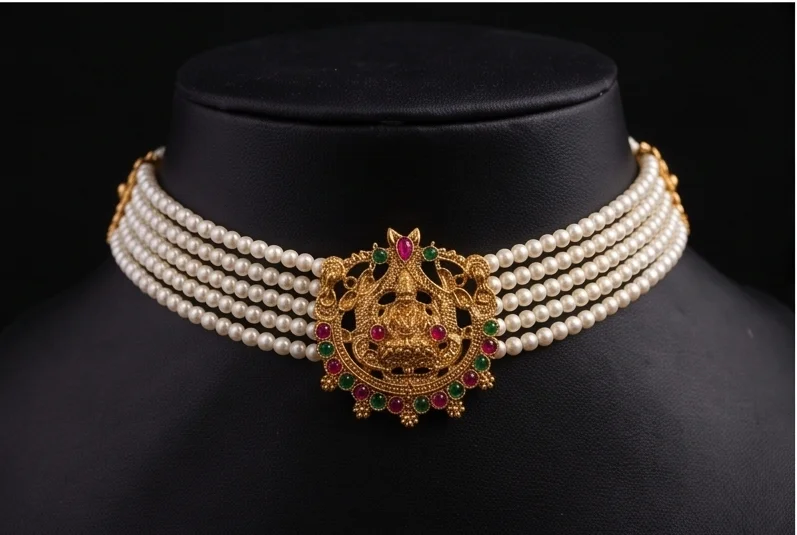
Stones make up much of the character and cost of imitation jewellery. Three of the most common are kemp, CZ and polki-look stones. Each fits a different customer and region, so choosing the right one per range is a real stocking decision.
What each stone is
- Kemp: cut and polished coloured glass, usually ruby red or emerald green, set in closed antique gold settings. The signature of South Indian temple jewellery. See what kemp stone is made of.
- CZ (cubic zirconia): a lab-made crystal, faceted for sparkle. Called AD (American Diamond) in India.
- Polki-look: flat, uncut-diamond effect stones, usually glass or uncut CZ with foil backing, imitating traditional polki.
The stones side by side
| Kemp | CZ (AD) | Polki-look | |
|---|---|---|---|
| Material | Coloured glass, often foil-backed | Lab-grown cubic zirconia, faceted | Glass or uncut CZ with foil backing |
| Imitates | Ruby and emerald | Diamond and coloured gems | Uncut diamonds |
| Light | Deep glow in a closed setting | Bright sparkle and colourful fire | Soft, flat shimmer |
| Setting | Closed cups, adhesive or lac | Prongs, pave, channels | Closed settings, Kundan style |
| Tradition | South Indian temple and bridal | Modern, pan-Indian, party and bridal sparkle | North Indian royal and bridal |
| Main regions | Tamil Nadu, Karnataka, Andhra, Telangana, Kerala | Nationwide, metros | Rajasthan, Punjab, Delhi, Hyderabad |
Durability, and where each stone goes wrong
- Kemp glass is durable in closed settings but can chip at edges if knocked. Typical faults: mismatched reds, dark stones where the backing failed, stones that fall out of oversized cups.
- CZ is hard and resists scratches. Typical faults: cloudy or yellowish stones, uneven pave, weak prongs that let stones drop out.
- Polki-look stones depend on their foil backing; moisture can dull foil over time, so sealed settings and dry storage matter. Typical faults: dull foil that makes stones look grey, uneven stone shapes, visible glue.
Knowing the typical failure of each helps you check samples quickly and brief your manufacturer precisely.
Price notes
Price depends more on stone count and setting labour than on stone type alone. Pave CZ with hundreds of tiny stones can cost more to set than a kemp choker with fewer, larger stones. Ask for quotes on the same design in different stones if you want to compare.
Which to choose, by region
- Tamil Nadu, Kerala, Karnataka, Andhra and Telangana: kemp leads for bridal and temple wear; CZ for daily and reception wear.
- Punjab, Rajasthan, Delhi NCR, Gujarat: polki-look and Kundan for bridal; CZ for parties.
- Maharashtra: a mix, with traditional Maharashtrian styles alongside CZ and Kundan.
- Hyderabad: all three, often combined, reflecting the city's mixed traditions.
- Urban fashion and gifting: CZ.
- Diaspora markets: all three, depending on the community.
A simple rule: lead with the stone your customers' weddings use, then add CZ as the cross-regional bestseller. Polki-look and kemp are identity purchases tied to tradition; CZ is a style purchase that sells everywhere.
Combinations that sell
Kemp with CZ borders, polki-look centres with CZ halos, and kemp with pearl drops are all strong sellers because they bridge traditional and modern tastes.
We set all three at our Mumbai factory. See kemp jewellery wholesale and Kundan and Polki wholesale.
Care advice by stone
- Kemp: keep dry; moisture behind a stone can darken its backing. Store flat in a sealed pouch.
- CZ: the stone itself does not tarnish, but the plating around it can; wipe after wearing and store separately so stones do not scratch other pieces.
- Polki-look: foil backing is sensitive to water and perfume; keep dry and sealed.
Printing these three lines on a care card, matched to the stone type, cuts complaints that are really about storage.
Explaining the difference to customers
Many customers ask what the difference is. A simple way to put it at the counter: kemp is the red-and-green glow of South Indian temple jewellery, CZ is the diamond-like sparkle, and polki-look is the soft shine of uncut diamonds in royal North Indian jewellery. All three are imitation stones that recreate the look of precious ones at an accessible price.