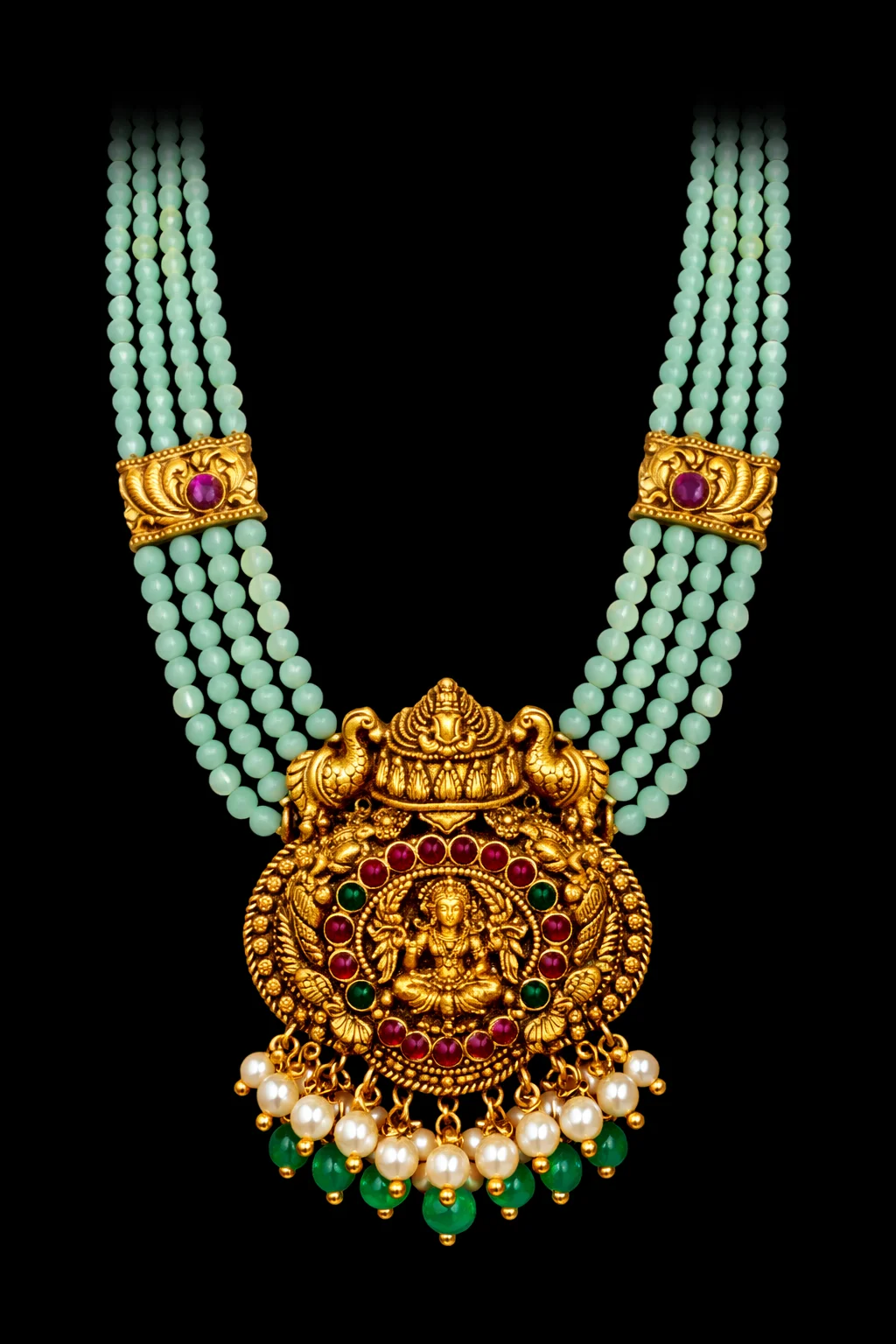
Knowing how imitation jewellery is made helps you ask better questions, judge quality faster and understand why prices and lead times vary. This is the process at a typical Indian imitation jewellery factory, including how we do it at Jagruti in Kandivali East, Mumbai.
1. Design brief
It starts with a reference: a photo, a sketch, an old piece, or a design from the catalogue. The brief records size, finish, stone type and colour, base metal and quantity.
2. 3D CAD or hand master
The design is modelled in 3D CAD software (we use Rhino with Matrix and Matrix Gold) or carved by hand. CAD lets us send a rendered proof for approval before any metal is cut, and makes exact size changes easy.
3. Master model
From the CAD file, a master is produced. The master is finished by hand so every detail is sharp.
4. Mould making
A rubber or metal mould is made from the master. Complex pieces may need several moulds for separate parts.
5. Casting
The base metal, Mazak (zinc alloy) or brass, is cast into the moulds. Mazak melts at a low temperature and fills fine detail; brass is heavier and suits traditional pieces. See what Mazak material means.
6. Cleaning, assembly and polishing
Castings are trimmed, parts are soldered or joined, and surfaces are polished.
7. Plating
Base layers go on first, then the final finish: antique gold, matte, high-polish, rhodium or oxidised. Read antique plating explained.
8. Stone setting
Kemp, CZ, Kundan glass, pearls and beads are set by hand. This is the most labour-heavy stage and the biggest source of quality differences.
9. Protective coat and finishing
An anti-tarnish lacquer is applied, then threads, hooks, screws and back chains are fitted.
10. Quality control
Every unit is checked against the approved sample: tone, stone colour and seating, joints, clasps and finish.
11. Packing and dispatch
Pieces are individually wrapped with anti-tarnish protection and packed for transport.
Inside the key stages
Mould making. For spin casting, the master is packed in rubber sheets and vulcanised under heat and pressure, then cut open so the master can be removed. The cavity it leaves is the mould. One mould is used for many casting cycles before it wears.
Casting. Molten zinc alloy (around 400 degrees Celsius) is poured into the centre of spinning moulds, and centrifugal force pushes it into every detail. Brass needs far higher temperatures and different methods, such as investment casting with plaster moulds.
Pre-plating. Castings are cleaned in degreasing and acid baths. Zinc alloy then receives a copper strike, a thin copper layer applied first because zinc reacts with many plating solutions.
Plating. The piece moves through a sequence of baths, each depositing a metal layer by electrolysis. The final layer sets the colour. For antique finishes, a darkening step and hand relief-polishing follow.
Stone setting. Stones are sorted by colour and size, then set by hand with adhesive, lac or prongs, depending on the style. A single bridal necklace may carry hundreds of stones.
Lacquering. A clear protective coat is sprayed or dipped and cured, sealing the plating against air and sweat.
Where defects come from
| Defect | Stage it starts | What prevents it |
|---|---|---|
| Porous or pitted surface | Casting | Clean alloy, correct temperature |
| Peeling plating | Pre-plating | Proper cleaning and copper strike |
| Patchy colour | Plating or antiquing | Controlled baths, skilled finishers |
| Loose stones | Setting | Correct cup size, good adhesive |
| Early tarnish | Lacquering and packing | Full lacquer coat, sealed packing |
How long does it take?
Lead time depends on design complexity, quantity and season. A new design adds the proof and sample stages. Repeat orders of existing designs are faster because moulds exist.
For a new design, the proof and sample stages usually take two to three weeks, and bulk production about a month after the sample is approved and the advance paid. For a repeat of an existing design, production starts almost at once, because the moulds and stone lists already exist. The longest single stage in bulk is usually stone setting, because it is done by hand, piece by piece.
Why this matters to wholesale buyers
When you understand the stages, you can see where cost and quality come from: the design and moulds are fixed costs spread over quantity, and plating and setting are per-unit labour. That is why factories set MOQs, and why sample approval matters.
Start a design with our custom design service.