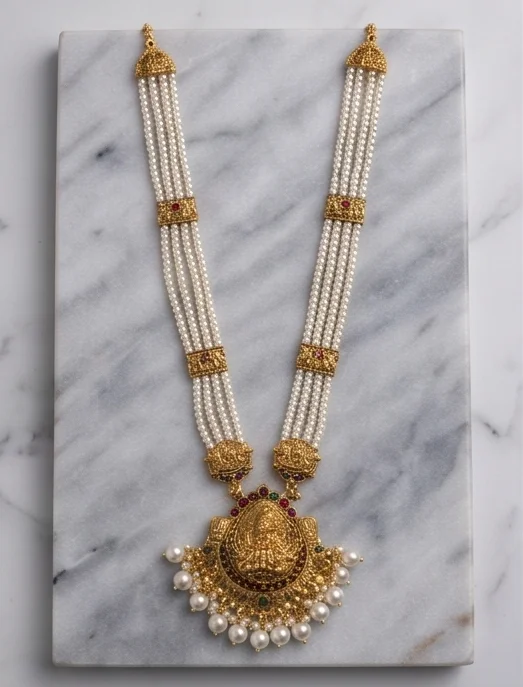
"Artificial jewellery", "imitation jewellery" and "fashion jewellery" are the same product in export trade: pieces made of base metal, brass or alloy, plated and set with glass or synthetic stones. Customs classifies all of it under HS heading 7117. This guide is about the demand side of exporting it from India: who buys, which designs each market wants, and how an order with an Indian factory is run. If you want the paperwork step by step, read the starter guide to imitation jewellery export.
How big is the export trade
Trade-data sites put India's imitation jewellery exports at roughly US$ 130 to 150 million a year, about Rs 1,150 crore in 2024-25. Figures differ by source and year, so treat them as a rough scale rather than an exact number. It is a small slice of the global trade, which is dominated by China, and India's strength is a specific one: ethnic, bridal and festive designs that a mass producer does not make well.
By value, the United States is the largest single market (roughly a quarter of exports), followed by the United Kingdom. France, Spain and Germany, the UAE, Canada and Australia follow. Check current figures on a trade-data site before you quote them to anyone.
Who actually buys
- South Asian jewellery and bridal shops in the US, UK, Canada, the Gulf, Singapore and Australia, restocking each wedding and festival season.
- Bridal outfit stores and wedding rental businesses that sell or hire jewellery with lehengas and sarees.
- Online sellers shipping to the diaspora and, increasingly, to buyers who like Indian statement jewellery without being of Indian origin.
- European fashion accessory importers, who buy lighter oxidised and statement pieces rather than heavy bridal sets.
What sells in each market
| Market | Designs that move | Guide |
|---|---|---|
| USA | Bridal and festive sets, oxidised fusion pieces | Exporting to the USA |
| UK | Kundan and polki-look bridal, colour-matched sets | Exporting to the UK |
| UAE and Gulf | South Indian temple and kemp, heavy bridal sets | Exporting to the UAE |
| Canada | Punjabi bridal, Gujarati festive, temple sets | Exporting to Canada |
| Australia, New Zealand | Bridal, temple and dance sets | Australia and New Zealand |
| Singapore, Malaysia | Temple, kemp and Bharatanatyam sets | Singapore and Malaysia |
Each country also has its own duty, tax and safety rules, summarised in our guide to import duty by country.
What overseas buyers ask a factory
- Which base metal and plating, and is it nickel-free? Europe, the UK, the US and Canada regulate nickel and lead. See nickel and lead compliance.
- Does every design have a code, so that a reorder matches the first order exactly?
- How is it packed? Sealed bags, anti-tarnish protection and numbered cartons matter more on a long sea or air journey. See export packaging.
- What is the minimum per design, and the lead time?
- What is the price basis? FCA or FOB, not just "per piece". See EXW vs FOB vs CIF.
How an overseas order works with Jagruti
- Minimum order: 200 pieces per design, 400 for earrings and pendants. You can combine several designs in one order as long as each reaches its minimum.
- Lead time: made to order, usually about one month after confirmation.
- Choosing designs: from the wholesale catalogue, by design code. Photographs, sizes and finish details are on the page, and you can ask for more photographs.
- Approval: for catalogue orders you pay a 60% advance, we make the order, and we send a video of the finished stock. The 40% balance is paid after you approve it.
- Overseas samples are on request, case by case. Overseas samples are arranged on request, case by case, depending on your country and the bulk order you plan. The buyer pays door to door: the sample cost, air freight, export and import customs clearance and duty, and road delivery to your address. It takes longer than a sample within India. This covers catalogue, made-to-order and custom samples. Most overseas buyers skip them and approve on photographs and the finished-stock video before the balance is paid. Buyers within India can order paid samples through a trade account.
- Price basis and paperwork: quoted FCA or FOB Mumbai, with commercial invoice, packing list and, where a trade agreement applies, a certificate of origin. See the export documents checklist.
Details of our export supply are on the export page.
Start small, then repeat
Most overseas retailers do not buy a whole catalogue at once. A practical first order is three to five proven designs at the minimum quantity, in the colours your customers buy, then a repeat once they have sold. Repeat orders are quicker because the design codes are already agreed.
To start, send your target market, the designs you like and your quantity through the enquiry form.